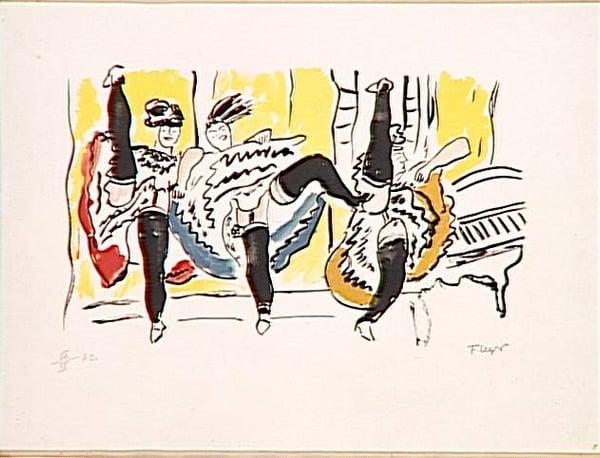
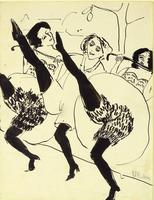
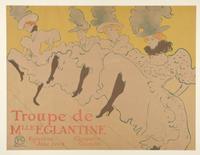
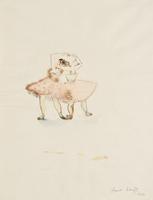
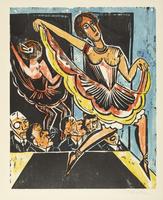
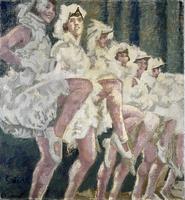
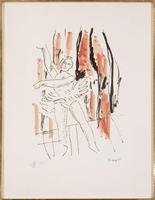
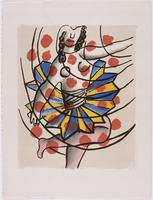
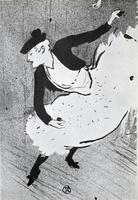
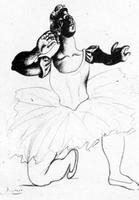
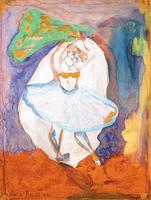
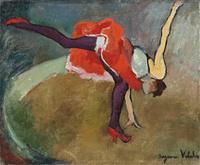
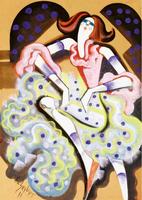
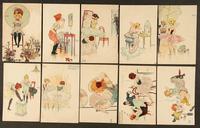
Fernand Léger’s The Cancan (sketch and study, Naïve Art/Primitivism) is a fascinating departure from the artist’s better-known Cubist and mechanical works. Here, Léger deliberately adopts a raw, untutored aesthetic—reducing the famed dance to its barest, most visceral forms. The sketch-like quality is not a flaw but a statement: Léger strips away academic precision to capture the explosive energy and rhythmic motion of the cancan. The figures are simplified into bold, almost childlike outlines, with exaggerated limbs and flat, unmodulated color planes. This aligns with Primitivism’s rejection of Western naturalism in favor of a more direct, “primitive” visual language—one that Léger uses to highlight the dance’s primal, chaotic spirit. The significance lies in his ability to fuse modern urban entertainment with a deliberately archaic, folk-art sensibility. Rather than a finished masterpiece, The Cancan is a study in essence: a celebration of pure movement and popular culture, stripped of all pretension. In this, Léger anticipates the later embrace of naïve art by modernists seeking authenticity beyond academic traditions.