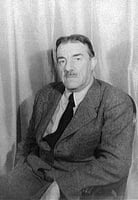
Expertenanalyse zu Fernand Legers The House under the trees
Stil: Cubism · Genre: landscape
Expert Analysis: "The House under the trees" by Fernand Léger
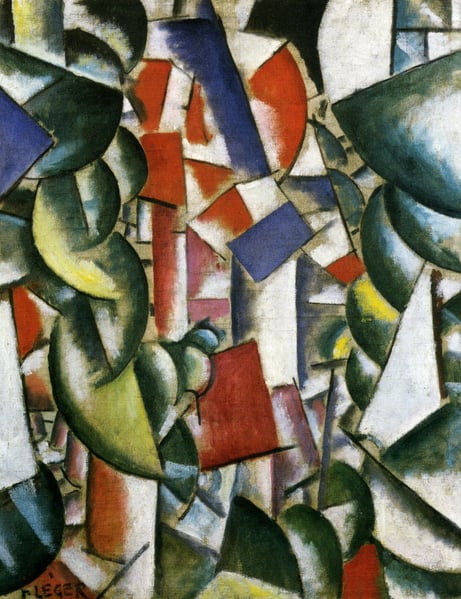
Fernand Léger’s "The House under the trees" stands as a compelling example of how Cubism — particularly its later, more synthetic phase — could be adapted to a seemingly traditional genre like landscape. While early Cubism (Picasso, Braque) often deconstructed still lifes and figures into muted, fragmented planes, Léger infused the movement with a bold, industrial vitality. This painting is significant for its distinctive treatment of form and color within the Cubist idiom.
Key Stylistic and Period Significance:
-
Tubular and Mechanical Forms: Unlike the more angular, faceted planes of Analytic Cubism, Léger favored cylindrical, conical, and machine-like shapes — a hallmark of his "Tubism." Here, the house is rendered as a stack of clean geometric volumes (rectangles, cylinders), while the trees are reduced to simplified, pipe-like trunks and rounded canopies. This mechanical vocabulary makes the natural subject feel constructed, as if built from factory parts — a nod to the modern, industrial age.
-
Contrast and Visual Tension: The composition sets the rigid, man-made house (straight lines, primary forms) against the organic, curvilinear trees (lobed shapes, overlapping arcs). Yet Léger unifies them through a shared Cubist logic: both are broken into distinct, overlapping color zones — deep greens, earthy browns, crisp whites, and muted reds. This tension between nature and construction is a central theme, reflecting the early 20th-century dialogue between the rural and the urban.
-
Synthetic Color and Bold Outlines: While early Cubists often suppressed color in favor of structure, Léger employed vivid, contrasting hues applied in flat, unmodulated patches. Thick black or dark contours define each shape — a technique borrowed from stained glass and popular posters — which gives the landscape a graphic, dynamic energy. The result is a scene that feels simultaneously playful and monumental.
-
Legacy within Cubism and Beyond: Léger’s landscapes like this one helped push Cubism toward a more accessible, decorative, and public-facing aesthetic. They foreshadowed his later Purist works and his interest in murals and film. "The House under the trees" demonstrates that Cubism was not confined to the studio still life; it could transform the pastoral landscape into a vibrant, fragmented vision of a modern world where nature itself is reimagined through a lens of technology and geometry.
In summary, this work is significant for its fusion of Cubist deconstruction with Léger’s signature machine-age forms, bold color, and a focus on the human-made versus the natural — capturing the spirit of a society in rapid transformation.
Visuell ähnlich
20 Werke mit ähnlicher Komposition und Farbpalette
Naked model in the workshop
Fernand Leger
Contrast of forms
Fernand Leger
City at Night
Aleksandra Ekster
Small Composition III
Franz Marc
Bureau and Room
Kazimir Malevich
Propellers 2nd state
Fernand Leger
Composition
Georges Valmier
Vanity Box
Kazimir Malevich
The lady at the piano
Kazimir Malevich
Composition
Fernand Leger
Portrait of Ivan Kliun
Kazimir Malevich
Contrast of form
Fernand Leger
Contrast of Forms
Fernand Leger
Paysage
Albert Gleizes
A glass
Pablo Picasso
Small Composition II
Franz Marc
Plastic Rhythm of the 14th of July
Gino Severini
Still life with harp and violin
Georges Braque
Factories
Fernand Leger
Smokers
Fernand Leger