Expertenanalyse zu Fernand Legers The Station
Stil: Tubism · Genre: cityscape
Expert Analysis of "The Station" by Fernand Léger
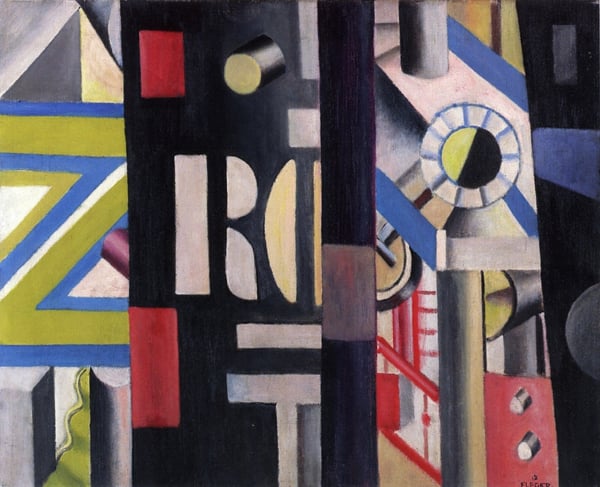
This work, The Station, is a quintessential example of Fernand Léger’s Tubism—a term coined to describe his distinctive approach to Cubism that emphasizes cylindrical, tube-like forms over the faceted planes favored by Picasso and Braque. As a cityscape, the artwork captures the industrial energy of early 20th-century urban life, transforming a mundane railway station into a dynamic symphony of mechanical shapes.
Significance within Tubism and the Period:
- Radical Simplification: Léger reduces the station’s architecture, trains, and figures into interlocking cylinders, cones, and spheres. This abstraction eschews naturalistic detail in favor of a visual language that mirrors the mass-produced, machine-made world. The result is a composition where human presence is subsumed by the relentless geometry of modern infrastructure.
- Celebration of Modernity: Unlike many Cubists who still hinted at traditional still lifes or portraits, Léger’s cityscape directly engages with the subject of transportation and industry—hallmarks of the Machine Age. The station becomes a stage for movement, with sharp diagonals and overlapping discs suggesting speed, steam, and mechanical rhythm.
- Pictorial Space: Léger rejects traditional perspective. Instead, he builds space through the stacking and overlapping of tubular volumes, creating a shallow, densely packed surface that pushes the scene toward the viewer. This flattening, combined with bold primary colors (often applied in flat, unmodulated patches), gives the painting a poster-like immediacy and a sense of controlled chaos.
- Influence on Later Movements: The Station foreshadows Léger’s later “mechanical period” and his lasting impact on Purism, Precisionism, and even Pop Art. His Tubist cityscapes directly influenced artists seeking to reconcile abstraction with the visual experience of the modern city.
In summary, The Station is not merely a depiction of a place but a manifesto of Tubism—a style that found beauty in the industrial and rendered the world as a harmonious assembly of machine parts. Its significance lies in how Léger translated the noise, speed, and geometric order of urban life into a bold, non-representational vocabulary that still feels startlingly contemporary.
Museum / Gallery
Visuell ähnlich
20 Werke mit ähnlicher Komposition und Farbpalette
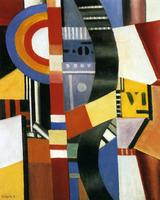
The Disc
Fernand Leger
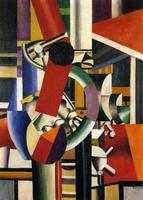
Still life
Fernand Leger
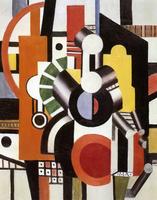
Machine elements
Fernand Leger
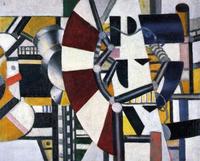
Machine elements
Fernand Leger
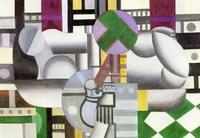
The birds in the landscape
Fernand Leger
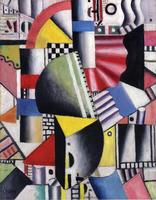
Factories
Fernand Leger
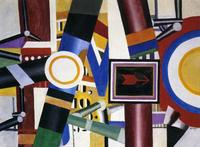
The level crossing (final state)
Fernand Leger
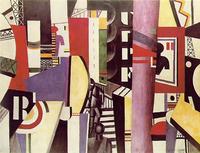
The Сity
Fernand Leger
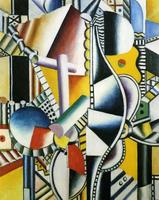
Propellers 2nd state
Fernand Leger
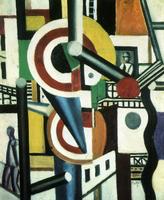
Two discs in the city
Fernand Leger
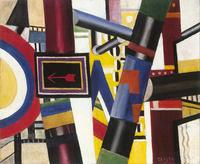
The railway crossing
Fernand Leger
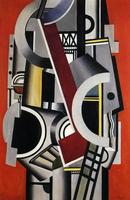
Machine element
Fernand Leger
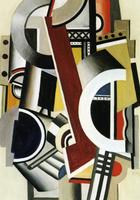
Machine element 1st state
Fernand Leger
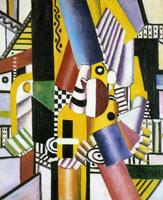
The Stove
Fernand Leger
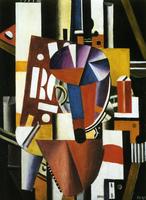
The typographer
Fernand Leger
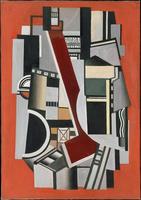
Mechanical Elements on red background
Fernand Leger
Cylinders
Karl Knaths
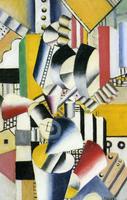
Contrast of Forms
Fernand Leger
Still Life
Fernand Leger
Mechanical compositions
Fernand Leger