Expertenanalyse zu Fernand Legers The two women in blue vase
Stil: Cubism · Genre: nude painting (nu)
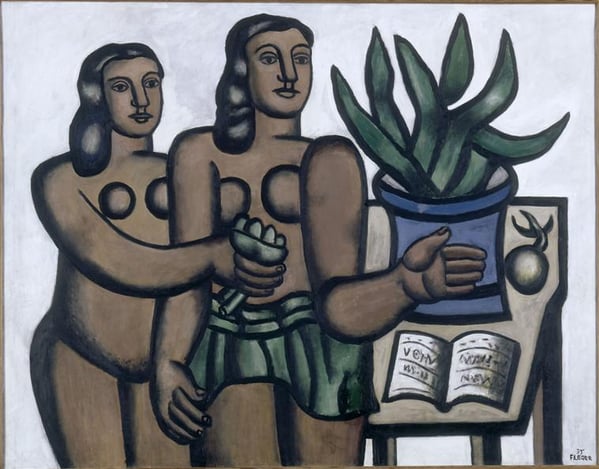
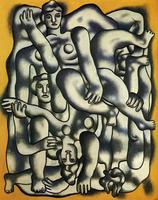
Fernand Léger’s The Two Women in Blue Vase (c. 1920–1922) stands as a bold synthesis of Cubist structure and the artist’s own fascination with the mechanical, industrial aesthetics of modern life. While the painting is classified as a nude (nu), Léger reimagines the traditional genre by rendering the female figures not through soft, organic curves but as a dynamic assembly of cylinders, cones, and geometric planes. This approach aligns with his post-World War I “mechanical period,” where human forms are treated with the same precision as machine parts, emphasizing rhythm, contrast, and clarity.
What makes this work significant within Cubism and Léger’s oeuvre:
-
Cubism’s evolution toward purism: By the early 1920s, Léger moved beyond the analytical fragmentation of early Cubism. Here, he employs broad, unmodulated color planes (vibrant blues, reds, and yellows) and sharp, simplified contours—a style that would influence the Purist movement championed by Le Corbusier and Ozenfant. The “blue vase” acts as a compositional anchor, its strong verticality contrasting with the rounded, tubular limbs of the women.
-
Reimagining the nude for the industrial age: Unlike the sensual, naturalistic nudes of the past, Léger’s women are de-individualized, almost robotic. Yet their stacked, interlocking forms generate a surprising sense of rhythmic harmony and monumentality. This reflects Léger’s belief that modern art should mirror the speed, volume, and order of urban/industrial experience—a radical departure from the introspective intimacy of earlier Cubist nudes (e.g., Braque or Picasso).
-
Color as structural force: Léger famously declared that “the modern conception of art is based on contrasts.” In this painting, the deep cobalt blue of the vase and the women’s bold red-orange forms set off a visual vibration. These colors are not descriptive but autonomous, creating spatial depth through pure chromatic opposition rather than perspective—a key contribution to early abstraction.
-
The fusion of figure and still life: By placing a still-life object (the blue vase) on equal footing with the human figures, Léger blurs the hierarchy between animate and inanimate. The vase’s rounded shape mirrors the women’s breasts and shoulders, suggesting that all matter—human, ceramic, machine—is subject to the same geometric laws. This democratic treatment of subjects anticipates later Pop and modernist design aesthetics.
In sum, The Two Women in Blue Vase encapsulates Léger’s unique contribution to Cubism: a robust, optimistic visual language that celebrates the modern world without losing the humanist core of painting. It stands as a pivotal work, bridging the fractured spaces of Analytic Cubism and the bold, poster-like clarity of interwar modernism.
Museum / Gallery
Visuell ähnlich
20 Werke mit ähnlicher Komposition und Farbpalette
Guyasdoms D'Sonoqua
Emily Carr
Three women with flowers
Fernand Leger
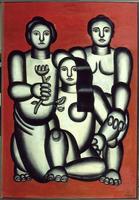
Three girls on red background (composition with three women)
Fernand Leger
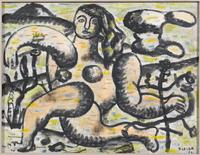
The kneeling woman
Fernand Leger
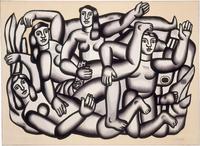
The Bathers
Fernand Leger
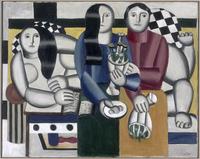
Trouville
Fernand Leger
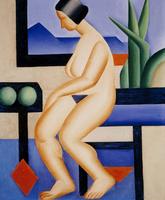
Study (Academy No. 2)
Tarsila do Amaral
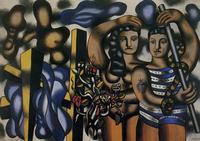
Adam and Eve
Fernand Leger
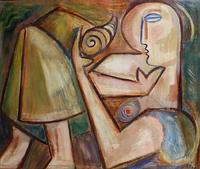
The Shell
Eileen Agar
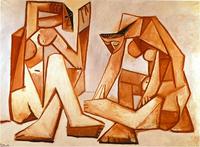
Two women on the beach
Pablo Picasso
Tři Grácie
Emil Filla
Circuse
Eric Massholder
Two Figures, naked on red bottom
Fernand Leger
The Bathers
Fernand Leger
Koupel nohou
Josef Capek
Three Characters
Fernand Leger
Leonie
Constant Permeke
Study for The Bathers
Fernand Leger
Acrobats in gray
Fernand Leger
The Drought Breaks, The People of Zookfontein
Walter Battiss