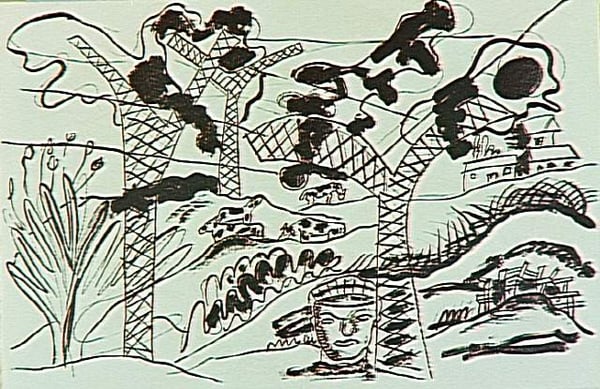
The album "Circus"
Details
Expert analysis of Fernand Leger’s The album "Circus"
Style: Naïve Art (Primitivism) · Genre: sketch and study
Expert Analysis: "The album 'Circus'" by Fernand Léger
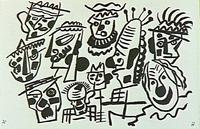
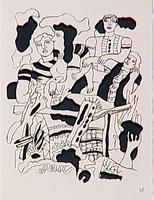
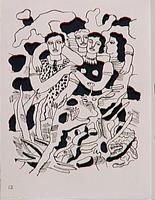
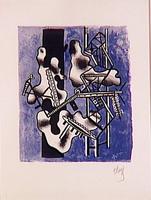
While Fernand Léger is widely celebrated for his Cubist-inspired mechanical forms and bold colors, "The album 'Circus'" occupies a distinctive place in his oeuvre by explicitly engaging with Naïve Art (Primitivism) —a style he rarely adopted. This work is a sketch and study, meaning it likely served as a preparatory or exploratory piece, capturing the raw, unfiltered energy of the circus without the polished precision of his finished paintings.
Significance within Naïve Art and Léger’s Career:
-
Departure from Mechanized Modernity:
Léger’s signature style often depicted the machine-age cityscape with tubular, industrial forms. Here, by embracing Naïve Art, he strips away that geometric complexity. The sketch’s crude lines and simplified figures evoke the untutored, childlike directness of Primitivism—a movement that valued spontaneity over academic technique. This contrast highlights Léger’s versatility and his ability to channel the circus’s anarchic vitality through a deliberately “unrefined” visual language. -
The Circus as a Primitivist Subject:
The circus—with its acrobats, clowns, and exotic animals—has long been a theme for artists seeking raw emotional spectacle (e.g., Picasso, Seurat). Léger’s choice to treat it in a sketch-and-study format reinforces the transitory nature of performance. The lack of finish mirrors the ephemeral, improvisational quality of a live circus act, making the work feel immediate and alive. The Naïve style further amplifies this: the figures appear almost caricature-like, as if drawn by a performer’s own hand between acts. -
Genre as Formal Experiment:
Because this is a sketch/study rather than a polished painting, we see Léger’s creative process laid bare. The fast, economical lines and unblended colors typical of Naïve Art allow him to test composition and gesture. In art historical terms, "The album 'Circus'" bridges Léger’s rational, constructed compositions with the instinctive, unmediated freedom of Primitivism—a dialogue that anticipates later 20th-century interests in outsider art.
Conclusion:
This work is significant not for its technical finish but for its radical stylistic shift. It proves that even a leading modernist like Léger could temporarily set aside Cubist sophistication to capture the primal thrill of the circus through the eyes of a “naïve” observer. The sketch’s brevity is its strength: it records a moment of pure artistic spontaneity, making "The album 'Circus'" a key document of Léger’s experimental range.
Museum / Gallery
Visually similar
20 works with related composition and palette
The album "Circus"
Fernand Leger
working drawing for `Primrose Hill'
Frank Auerbach
The album "Circus"
Fernand Leger
Untitled
Francois Arnal
Untitled
Houria Niati
Untitled
Fred Bugs
Tree in Tretire II
Frank Auerbach
Kondor Béla, Városrom
Kondor Béla
21/1990
Emil Schumacher
Discovery of Acid (Act I) [Découverte de l'acide (acte I)]
Pierre Alechinsky
Fantastic landscape. Settlement in the mountains.
Martiros Sarian
The album "Circus"
Fernand Leger
The album "Circus"
Fernand Leger
Untitled
Afro
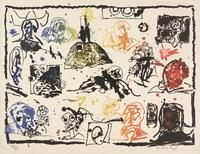
One Stone, Two Passes
Pierre Alechinsky
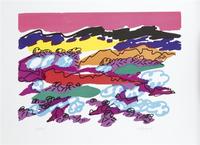
Montagne en Haute Provence
Charles Lapicque
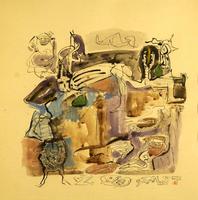
Untitled
Vasile Kazar
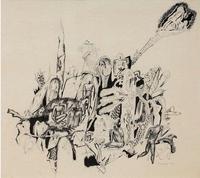
Primordial Scene
Walter Battiss
Mechanical Elements on a blue background
Fernand Leger
Alpilles, MP309
Mario Prassinos