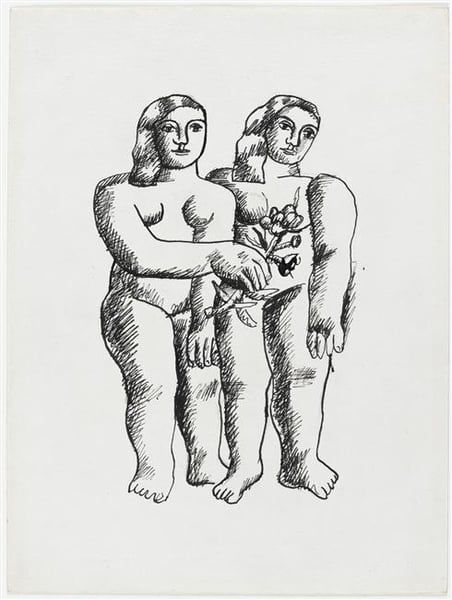
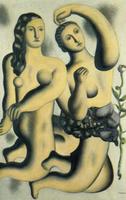
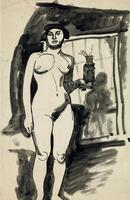
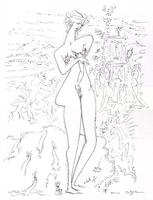
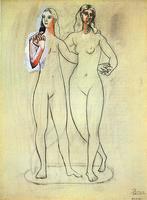
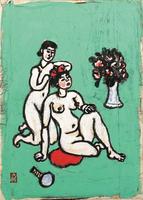
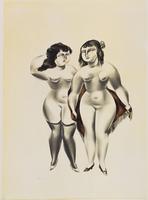
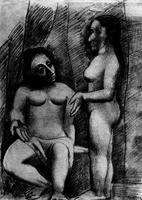
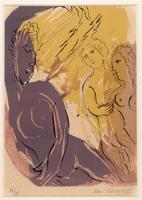
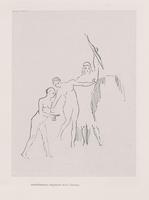
This sketch and study, Two Women (Two Sisters) by Fernand Léger, holds significance within the Cubist movement as a concentrated example of Léger’s unique contribution to the style. As a sketch, it reveals the artist’s working process—a raw, unfiltered exploration of form and composition that is central to Cubist practice. The genre emphasizes the analytic deconstruction of the human figure, a hallmark of Cubism, but Léger’s approach here stands out for its mechanical precision and simplification of volume into tubular, machine-like shapes. Even in a study, he prioritizes bold contrasts and the dynamic interplay of abstracted planes, bridging the intellectual rigor of early Cubism with a more robust, industrialized aesthetic that would define his later work. This piece thus serves as a key document of Léger’s stylistic evolution within the period, demonstrating how Cubist methods could be adapted to convey modern, urban vitality even in preliminary form.