
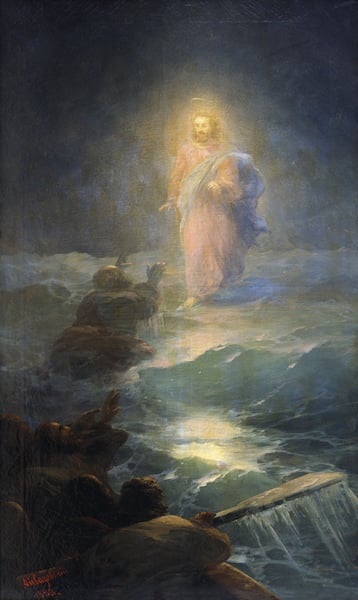
Analisi esperta di Jesus walks on water di Ivan Aivazovsky
Stile: Romanticism · Genere: religious painting
Expert Analysis: Jesus Walks on Water by Ivan Aivazovsky
Ivan Aivazovsky, celebrated as one of the greatest marine painters of the 19th century, brings his signature Romantic sensibility to the biblical story of Christ walking on the Sea of Galilee. This work is significant for the way it merges two distinct genres—religious painting and the maritime sublime—creating a dramatic, emotionally charged landscape that embodies the core ideals of Romanticism.
Composition and Theatricality
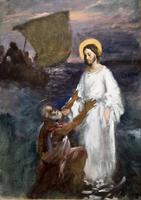
Aivazovsky places the viewer at the mercy of a storm-tossed sea. Towering, foaming waves dominate the canvas, their turbulent forms rendered with his characteristic fluid brushwork and translucent layers of glaze. In the midst of this chaos, a small fishing boat—containing the terrified apostles—is tilted precariously. Christ appears as a radiant, calm figure striding across the water toward the vessel, his silhouette illuminated by a burst of celestial light breaking through the dark clouds. This stark contrast between the natural ferocity of the storm and the serene, supernatural presence of Christ is a hallmark of Romantic landscape painting: nature as both a violent, untamable force and as a stage for spiritual revelation.
Light and Atmosphere
Aivazovsky was a master of light effects, and here he uses light to convey theological meaning. The moon’s reflection on the churning water creates a shimmering path, while a golden halo around Christ’s head diffuses into the surrounding storm. The interplay of moonlight, cloud-filtered sunbeams, and the phosphorescence of the waves evokes the sublime—a feeling of awe mixed with terror. This aligns perfectly with Romanticism’s fascination with overwhelming natural phenomena and the human encounter with the divine.
Significance within Aivazovsky’s Oeuvre and Romanticism
While Aivazovsky is best known for his secular seascapes (e.g., The Ninth Wave), Jesus Walks on Water demonstrates his ability to infuse a religious subject with the same dynamic energy and atmospheric drama. The painting bridges the gap between traditional icon painting and Romantic landscape. It is not merely an illustration of a miracle; it is a meditation on faith versus nature’s overwhelming power. The vulnerable boat (symbolizing the Church or humanity) is dwarfed by the elements, yet Christ’s authority over creation is visually asserted through Aivazovsky’s luminous technique.
In the broader context of 19th-century Romantic religious art, this work stands out for its avoidance of sentimental piety. Instead, it embraces the storm as a metaphor for spiritual struggle and redemption. Aivazovsky’s Jesus Walks on Water remains a compelling example of how Romantic painters used landscape—specifically the sea—to explore themes of transcendence, danger, and divine intervention.
Visivamente simili
20 opere con composizione e palette affini
Jesus Walks on Water
Ivan Aivazovsky
Jesus walks on water
Ivan Aivazovsky
Denying Satan
Carl Bloch

Shipwreck of Lefort
Ivan Aivazovsky
Jesus Tempted
Carl Bloch
The Ascension Of Christ
Rembrandt

Follow me, Satan
Ilya Repin

Three Witches (scene from Macbeth)
William Rimmer
Jonah
Albert Pinkham Ryder
And the Spirit of God Moved on the Face of the Waters
Ivan Aivazovsky
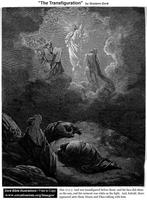
The Transfiguration
Gustave Dore
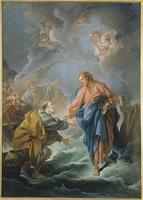
St. Peter Invited to Walk on the Water
Francois Boucher
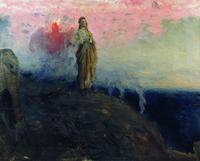
Follow me, Satan (Temptation of Jesus Christ)
Ilya Repin
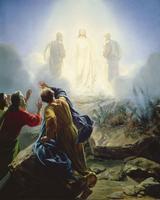
Transfiguration of Jesus
Carl Bloch
Christ
Jan Matejko
The Resurrection of Christ
Rembrandt

Adoration of the Magi
Domingos Sequeira
Jesus Christ
Vladimir Makovsky
The Ascension
John Singleton Copley
Christ Walks on Water
Eero Järnefelt