
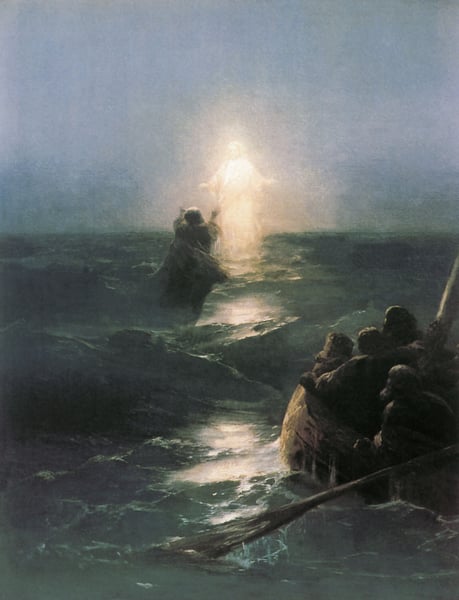
Analisi esperta di Jesus walks on water di Ivan Aivazovsky
Stile: Romanticism · Genere: religious painting
Expert Analysis of "Jesus walks on water" by Ivan Aivazovsky
Ivan Aivazovsky’s Jesus walks on water is a striking fusion of two of Romanticism’s most potent subjects—the sublime power of nature and the transcendent drama of faith. While the artist is celebrated primarily as a master of marine painting, this religious work demonstrates how Romanticism’s emphasis on emotion, awe, and the sublime can be channeled into a biblical narrative.
Significance within Romanticism:
-
The Sublime in Nature and Faith: Romantic painters often depicted nature as a vast, uncontrollable force that evokes both terror and wonder. Here, Aivazovsky sets the miracle against a storm-tossed sea—dark, churning waves, a turbulent sky, and a sliver of moonlight breaking through clouds. This is not a calm, serene biblical scene; it is a chaotic, elemental moment. The raging water embodies nature’s overwhelming power, while Christ’s calm figure walking upon it represents divine authority over that chaos. The contrast creates a quintessential Romantic tension: human frailty (the disciples in the boat) versus the sublime presence of the divine.
-
Light and Atmosphere: Aivazovsky was a virtuoso of light. In this painting, he likely uses a dramatic, almost theatrical light source—perhaps the moon or a celestial glow around Christ—to isolate the savior from the surrounding darkness. This technique heightens the emotional impact, guiding the viewer’s eye to the miracle while the storm remains a threatening backdrop. Such manipulation of light to evoke spiritual awe is a hallmark of Romanticism, echoing the works of Turner or Friedrich.
-
Emotion and Individual Experience: The disciples in the boat are rendered as small, vulnerable figures, overwhelmed by both the storm and the wonder they witness. Their reaction—fear, awe, hope—anchors the viewer’s own emotional response. Romantics prioritized subjective feeling over objective realism; this painting invites us to experience the terror and the grace simultaneously.
Genre and Religious Significance:
As a religious painting, Jesus walks on water transcends mere illustration. It aligns with the Romantic tendency to reinterpret biblical stories through the lens of nature’s power and personal spiritual experience, rather than through church dogma. Aivazovsky’s decision to make the sea the true protagonist—alongside Christ—underscores the Romantic belief that God is most directly felt in the untamed natural world. This work stands out among Aivazovsky’s oeuvre for its explicit theological subject, proving his range beyond pure seascapes.
Conclusion:
Jesus walks on water is significant because it merges Aivazovsky’s unmatched marine technique with a profound religious theme, creating a Romantic masterpiece where the sea becomes both a symbol of earthly peril and a stage for divine intervention. It exemplifies how Romanticism used nature’s sublime force to explore spirituality, making the invisible visible through light, motion, and emotion. This painting remains a powerful testament to the era’s belief that art could reveal the transcendent through the dramatic and the beautiful.
Visivamente simili
20 opere con composizione e palette affini
Jesus Walks on Water
Ivan Aivazovsky
Shipwreck of Lefort
Ivan Aivazovsky
Jesus walks on water
Ivan Aivazovsky
And the Spirit of God Moved on the Face of the Waters
Ivan Aivazovsky
Farewell
Ivan Aivazovsky
The Ninth Wave. Study
Ivan Aivazovsky
The Shipwreck in a stormy sea
Ivan Aivazovsky
Sea at night
Ivan Aivazovsky
Jonah
Albert Pinkham Ryder
The birth of Aphrodite
Ivan Aivazovsky
The Sunrize
Ivan Aivazovsky
The Moonrize in Feodosiya
Ivan Aivazovsky
Moonlight on the Norwegian Coast
Knud Baade
The Signal
James Webb
Heroine Bobolina with hunters breaks under a hail of shots on a boat through the Turkish fleet
Ivan Aivazovsky
After the storm. Moonrise
Ivan Aivazovsky
Lunar night on a sea
Ivan Aivazovsky
Sunset
Francis Danby
Lord Ullin's Daughter
Albert Pinkham Ryder
Sailing by Moonlight
Martin Johnson Heade