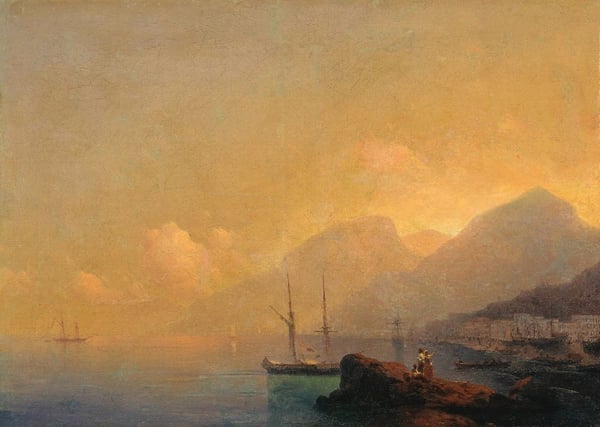
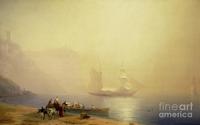
Seascape
Expertenanalyse zu Ivan Aivazovskys Seascape
Stil: Romanticism · Genre: landscape
Expert Analysis: "Seascape" by Ivan Aivazovsky
Ivan Aivazovsky (1817–1900) is widely regarded as the supreme master of the marine landscape within the Romantic tradition. Though the specific composition of this untitled seascape is not detailed in the given facts, the artist’s signature approach—rooted in the Romantic fascination with nature’s sublime power—allows for a meaningful analysis of the work’s significance.
Romanticism and the Sublime
Aivazovsky’s seascapes epitomize the Romantic obsession with the untamed, overwhelming forces of nature. In this painting, the sea is not a passive backdrop but a living, emotional entity—often tumultuous, illuminated by dramatic contrasts of light and shadow, and charged with a sense of the infinite. The artist’s ability to render the interplay of moonlight, storm clouds, or the golden glow of sunset on churning waves amplifies the viewer’s experience of the sublime, simultaneously awe-inspiring and humbling.
Mastery of Light and Atmosphere
Aivazovsky’s technical brilliance lies in his handling of transparency and luminosity. He famously painted directly from memory (rarely from life), achieving a near-photographic illusion of water’s shifting surface—translucent crests, deep cerulean troughs, and the misty diffusion of light through ocean spray. In a typical Aivazovsky seascape, the horizon dissolves into air and water, blurring the boundary between sea and sky, a hallmark of his atmospheric perspective.
Dynamic Composition and Movement
The Romantic preference for drama is evident in Aivazovsky’s diagonal lines, converging currents, and the sweeping arc of waves. Even if this specific seascape depicts a calm moonlit scene rather than a storm, his compositions always convey a latent energy—the ever-present potential for transformation. Ships, often tiny against the vast sea, underscore human fragility, a recurring Romantic theme.
Cultural and Historical Significance
Aivazovsky was celebrated across Europe and the Russian Empire, earning the title of academician and the patronage of the tsars. His seascapes elevated the marine genre from mere topographical record to a vehicle for emotional and philosophical expression. Moreover, as a Crimean Armenian, his works often carried personal resonance: the Black Sea, his frequent subject, was both his homeland and a symbol of cultural crossroads.
In summary, this unnamed “Seascape” by Aivazovsky is significant as a quintessential example of Romantic landscape painting at its most visceral—where the sea becomes a mirror for the human soul, and technical virtuosity is harnessed to evoke nature’s eternal, untamed majesty.
Visuell ähnlich
20 Werke mit ähnlicher Komposition und Farbpalette
Ships at anchor
Ivan Aivazovsky
Sunset over Yalta
Ivan Aivazovsky
Sea at night
Ivan Aivazovsky
Crimean view. Ayu-Dag
Ivan Aivazovsky
Night in Amalfi
Ivan Aivazovsky
Loading Provisions off the Crimean Coast
Ivan Aivazovsky
Coast of Labrador
William Bradford
Crimean coast
Ivan Aivazovsky
The Bay of Naples by Moonlight
Ivan Aivazovsky
Gurzuf
Ivan Aivazovsky

Alushta
Ivan Aivazovsky
Sunrise in Feodosia
Ivan Aivazovsky
Yalta. The mountains at night
Ivan Aivazovsky
Full Moon in the Scottish Lowlands near Berwik-upon-Tweed
Carlo Bossoli
The Bay of Yalta
Ivan Aivazovsky
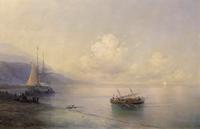
Seascape
Ivan Aivazovsky
Landscape with a schooner
Ivan Aivazovsky
Moonlight in Feodosia
Ivan Aivazovsky
The sunset on sea
Ivan Aivazovsky
Morning on the Shore of the Sea Sudak
Ivan Aivazovsky