
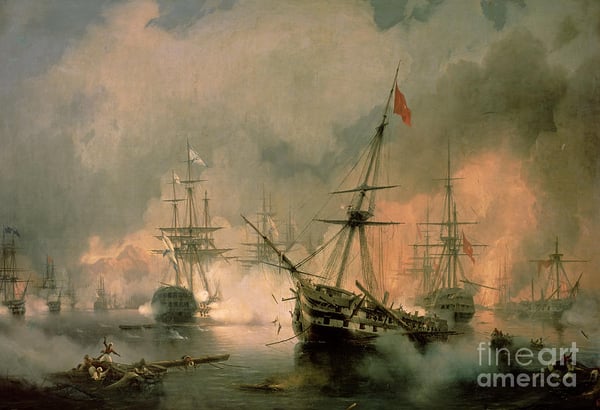
Expert analysis of Ivan Aivazovsky’s The Battle of Navarino
Style: Romanticism · Genre: battle painting
Expert Analysis: "The Battle of Navarino" by Ivan Aivazovsky
Ivan Aivazovsky’s The Battle of Navarino (1846) stands as a quintessential example of Romantic battle painting, fusing the genre’s emotional intensity with the artist’s unparalleled mastery of marine subjects. Set during the 1827 naval engagement of the Greek War of Independence—a key moment for Russian and allied intervention—the work transcends mere historical documentation to become a dramatic meditation on nature’s power and human conflict.
Significance within Romanticism:
Aivazovsky elevates a factual battle scene into a Romantic sublime spectacle. The composition is driven by turbulent waves, roiling smoke, and a stormy sky rent with flashes of fire and lightning. The sea itself becomes a protagonist—chaotic, overwhelming, and sublime—reflecting the Romantic preoccupation with nature’s raw, untamable force. The ship masts lean at precarious angles, flames erupt from hulls, and tiny figures struggle against the immensity of both ocean and war. This use of scale and atmospheric drama aligns with Romanticism’s emphasis on emotion, awe, and the heroic—and often futile—struggle of humanity.
Significance within battle painting:
While traditional battle paintings often center on ground troops or clear tactical narratives, Aivazovsky shifts focus to the maritime environment and its overwhelming sensory chaos. He pioneered a style that made naval warfare synonymous with the sublime; the clash of ships is secondary to the clash of elements. In Navarino, the viewer feels the heat of cannon fire and the sting of salt spray, not just the sequence of maneuvers. Aivazovsky’s technical brilliance in rendering water—translucent waves, reflections of flames on wet decks, and the variegated blues and grays of a stormy Aegean—elevates the work from reportage to transcendent Romantic symbolism.
What makes this artwork significant:
It is a landmark fusion of history painting and marine art in which Aivazovsky, a Russian-Armenian artist, celebrates a moment of allied cooperation (Russia, Britain, France) while asserting his own national pride. The painting captures not only a specific victory but also the Romantic ideal of nature as a mirror to human destiny—glorious, terrible, and beyond complete control. Its lasting importance lies in how it redefines battle painting: not as a dry chronicle but as an immersive, emotional spectacle that still resonates with the power of the sea and the cost of war.
Visually similar
20 works with related composition and palette
The Battle of Navarino
George Philip Reinagle
Russian-Turkish Sea Battle of Sinop on 18th November 1853
Ivan Aivazovsky
The Landing at Subashi
Ivan Aivazovsky
Naval battle at Lissa
Konstantinos Volanakis
The Bombardment of Sveaborg, 9 August 1855
John Wilson Carmichael
Bombardment of Algiers
Thomas Luny
Bombardment of Castillo de San Lorenzo by Admiral Vernon
John Cleveley the Elder
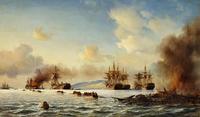
The Battle of Grand Port
Anton Melbye
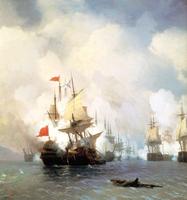
Battle of Chios on 24 June, 1770
Ivan Aivazovsky
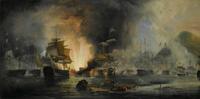
The Battle of Navarino, 20 October 1827
George Philip Reinagle
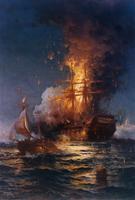
Burning of the Frigate Philadelphia in the Harbor of Tripoli
Edward Moran
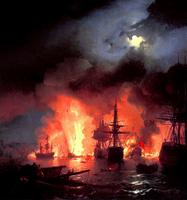
Battle of Cesme at Night
Ivan Aivazovsky
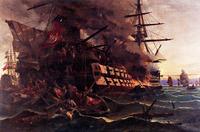
The attack on the Turkish flagship in the Gulf of Eressos at the Greek island of Lesvos by a fire ship commanded by Dimitrios Papanikolis
Konstantinos Volanakis
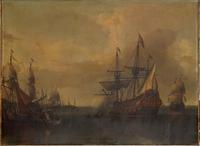
A Dutch three-master firing a salute, together with numerous other ships
Aernout Smit
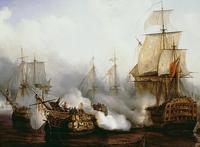
Battle of Trafalgar
Louis-Philippe Crépin
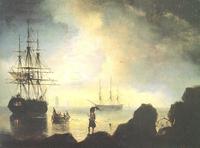
Fishermen on the Shore
Ivan Aivazovsky
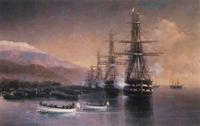
The landing to Subashi
Ivan Aivazovsky
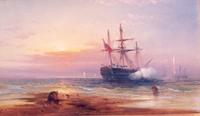
Salute at Sunset
Edward Moran
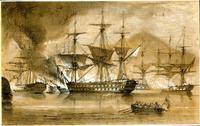
The Scipion on Entering the Harbour Ran Aboard the Brelots
George Philip Reinagle
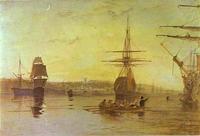
Cowes, Isle of Wight
J.M.W. Turner