Expert analysis of Ivan Aivazovsky’s Battle of Cesme at Night
Style: Romanticism · Genre: battle painting
Expert Analysis: "Battle of Cesme at Night" by Ivan Aivazovsky
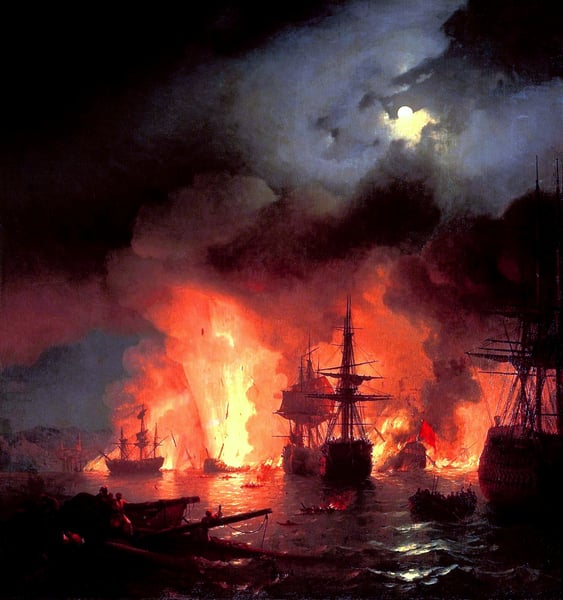
Ivan Aivazovsky’s "Battle of Cesme at Night" stands as a quintessential example of Romanticism in battle painting, elevating a historical naval engagement into a sublime, almost apocalyptic vision. Executed in the mid-19th century, the work captures the 1770 Battle of Çeşme, a pivotal Russo-Turkish War victory, but Aivazovsky transcends mere documentation to evoke the Romantic fascination with nature’s terrifying power and human heroism.
Significance within Romanticism:
The painting embodies the Romantic emphasis on emotion, dramatic light, and the sublime. Aivazovsky, primarily a marine painter, transforms the scene of warfare into a cosmic struggle. The night sky is torn by colossal explosions, with flames and smoke billowing upward, reflecting off churning waves. This use of chiaroscuro—contrasting fiery orange and deep indigo—creates a visceral sense of chaos and awe, a hallmark of Romanticism's attempt to overwhelm the viewer with nature’s might and human frailty. The burning ships are not merely tactical elements but symbols of destruction and transience, rendered with loose, expressive brushwork that prioritizes atmosphere over precise detail.
Significance within Battle Painting:
Unlike typical historical battle scenes focused on individual combat or orderly formations, Aivazovsky’s composition centers on the elemental forces of fire, water, and wind. The ships are dwarfed by the conflagration, emphasizing the overwhelming scale of the conflict. This approach redefines battle painting by making the natural environment—specifically the sea and sky—the primary protagonist. The lack of distinct human figures underscores the Romantic belief in collective destiny over personal glory. The work thus bridges marine art and history painting, offering a new paradigm where naval warfare is presented as a sublime, almost abstract spectacle.
Conclusion:
"Battle of Cesme at Night" is significant as a masterful fusion of Romanticism’s emotional intensity with the battle genre, showcasing Aivazovsky’s unparalleled ability to harness light and color to convey both historical drama and universal themes of mortality and nature’s supremacy. It remains a definitive example of how Romantic artists used historical events to explore deeper philosophical and aesthetic questions.
Museum / Gallery
Visually similar
20 works with related composition and palette
Battle of Sinop
Ivan Aivazovsky
Russian-Turkish Sea Battle of Sinop on 18th November 1853
Ivan Aivazovsky
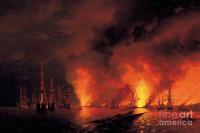
The Battle of Sinop on 18th November 1853 Night After Battle
Ivan Aivazovsky
Battle of Chesma
Ivan Aivazovsky
The Battle of Grand Port
Anton Melbye
Bombardment of Algiers
Thomas Luny
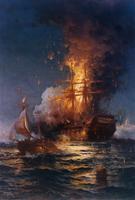
Burning of the Frigate Philadelphia in the Harbor of Tripoli
Edward Moran
Turkish steamships attack 44 gun fregate Flora
Alexey Bogolyubov
Fishermen on the Shore
Ivan Aivazovsky
The capture of Sevastopol
Ivan Aivazovsky
Lunar night on Capri
Ivan Aivazovsky
The Battle of Navarino
Ivan Aivazovsky
Tempest by Sounion
Ivan Aivazovsky
The Harbor At Odessa On The Black Sea
Ivan Aivazovsky
Fishermen on the coast of the sea
Ivan Aivazovsky
A sailing ship on a high sea by moonlight
Ivan Aivazovsky
Sea battle near Vyborg
Ivan Aivazovsky
The Battle of Navarino
George Philip Reinagle
Ships in the stillness of the night
Ivan Aivazovsky
Gibraltar by Night
Ivan Aivazovsky