Expert analysis of Jacques-Louis David’s Deputies swearing oaths
Style: Neoclassicism · Genre: history painting
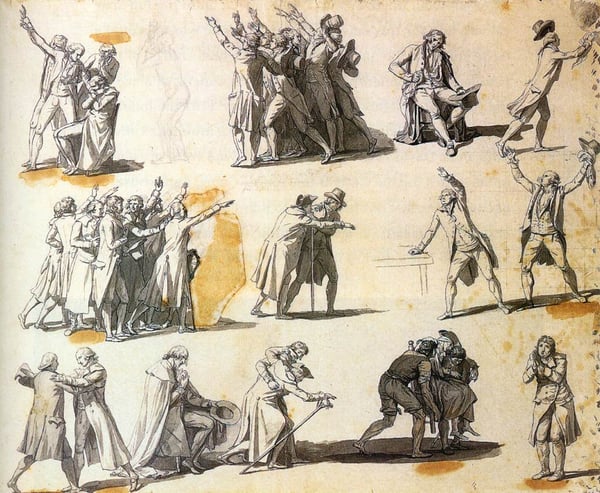
As an expert art historian, I can provide a focused analysis based solely on the supplied structured facts: the artwork is "Deputies swearing oaths" by Jacques-Louis David, created in the Neoclassical style and belonging to the genre of history painting.
Significance in Neoclassicism and History Painting
Jacques-Louis David was the preeminent painter of Neoclassicism, a style that sought to revive the moral clarity, civic virtue, and formal rigor of ancient Greco-Roman art. In this context, "Deputies swearing oaths" exemplifies the core Neoclassical mission: to use historical or contemporary events as vehicles for conveying ethical and political ideals.
The painting's significance lies in its fusion of a contemporary, politically charged subject with the elevated, didactic language of history painting. While David’s earlier masterpiece The Oath of the Horatii (1784) depicted a legendary Roman vow of loyalty to the state, "Deputies swearing oaths" applies the same solemn, oath-taking structure to a modern event—likely the Tennis Court Oath of 1789, where French deputies vowed to create a constitution. By treating a current revolutionary act with the gravity and compositional clarity of ancient history, David elevated political moments into timeless symbols of collective duty and sacrifice.
Neoclassicist history painting demanded clear, orderly composition, noble gestures, and a strong moral message. Here, the deputies are arranged in a frieze-like formation, their outstretched arms and upward gazes echoing Roman oratory and oath-taking. The use of light, space, and linear precision reinforces the gravity of the moment—each figure contributes to a unified, rational whole, embodying the Enlightenment ideals of reason and public virtue.
Thus, the work is significant because it collapses the distance between past and present, demonstrating that Neoclassicism was not merely a revival of antiquity but a living language for contemporary political transformation. David transformed a specific historical pledge into an enduring icon of democratic aspiration, making the painting a landmark in both Neoclassical art and the evolution of modern history painting.
Museum / Gallery
Visually similar
20 works with related composition and palette
Soldiers under the cross
Albrecht Durer
The Imprudence of the Second Youth, Plate 51
Daniel Chodowiecki
Several Neapolitan mutoparlant gestures
Saverio della Gatta
Nuccia accepts Meo Patacca for her husband (Plate 52/52)
Bartolomeo Pinelli
Judgment of Solomon
Willem van Swanenburg
Don Quixote
Gustave Dore
Scene from Wilhelm Tell
Josef Kriehuber
Allegory of Justice with a court scene depicting a man being pardoned by a judge
Willem van Swanenburg
America in Distress
Paul Revere
Don Quixote
Gustave Dore
Able Doctor
Paul Revere
Burning of William White, a Priest, Norwich, England, AD 1428
Jan Luyken
The Judge Bias, Shedding Tears
Willem van Swanenburg
Illustration for Baron von Münchhausen
Gustave Dore
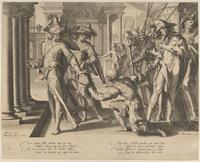
Allegory of Justice Depicting a Street Scene with a Shepherd Giving Paper to a Judge, Who Rejects It
Willem van Swanenburg
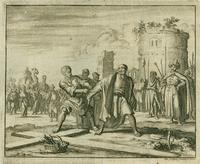
Crucifixion of Simon the Zealot, Syria, AD 70
Jan Luyken
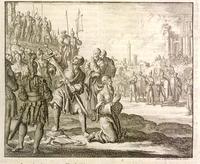
Apostle Paul Beheaded, Rome, AD 69
Jan Luyken
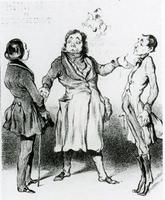
Robert Macaire Bureau of Military Replacements
Honore Daumier
Arrest of Christ
Albrecht Durer
Meeting of Moses and Jethro
Willem van Swanenburg