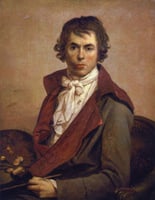
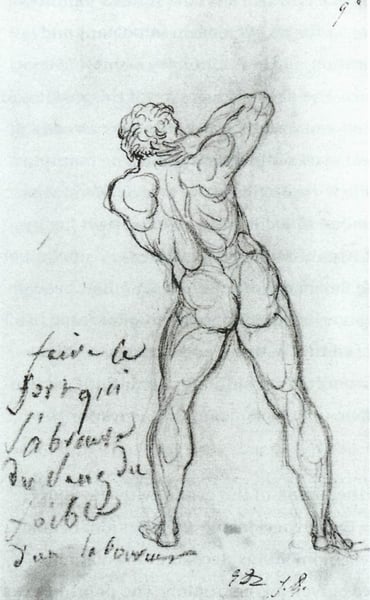
Expert analysis of Jacques-Louis David’s Study after Michelangelo
Style: Neoclassicism · Genre: sketch and study
Expert Analysis: "Study after Michelangelo" by Jacques-Louis David
Jacques-Louis David’s Study after Michelangelo is a revealing example of the Neoclassical artist’s disciplined engagement with the Renaissance canon. As a sketch and study, this work is not a finished public statement but a private, preparatory exercise—precisely the kind of rigorous draftsmanship that underpinned David’s authority as the leading painter of Neoclassicism.
Significance within Neoclassicism
-
Rooted in the Ideal: Neoclassicism championed clarity, order, and moral gravity, drawing inspiration from Greco-Roman art and the High Renaissance. By copying Michelangelo, David was not merely imitating but studying the master’s anatomical exaggeration, dynamic torsion, and monumental physicality—qualities that Neoclassical artists sought to temper with classical restraint. This study thus represents a dialogue between Renaissance dynamism and Neoclassical sobriety.
-
Evidence of Artistic Process: David’s sketch demonstrates the foundational role of drawing in Neoclassical practice. The careful rendering of musculature, contrapposto, and chiaroscuro highlights his belief that form must be built from careful observation and scholarly reference. Such studies were essential for major history paintings like The Oath of the Horatii (1784), where heroic figures echo Michelangelo’s sculptural weight.
-
A Link to Michelangelo’s Legacy: David’s choice to study Michelangelo (specifically the Sistine Chapel figures or sculptures like The Dying Slave) underscores the Neoclassical reverence for “the sublime” in Renaissance art. It shows that Neoclassicism was not a simple rejection of Baroque excess but a selective appropriation of past masters to achieve a new civic and moral clarity.
Art Historical Context
Unlike an independent portrait or finished composition, this sketch is a working document—a fragment that reveals David’s hand and mind at the moment of learning. Its significance lies in its function: as a studio exercise, it reminds us that Neoclassicism’s polished surfaces were built on relentless practice. For scholars, it offers insight into how David filtered Michelangelo’s tension and weight through the lens of 18th-century rationalism, ultimately forging the visual language of revolutionary France.
In short, Study after Michelangelo is a key to understanding David’s method: a study that transforms Renaissance precedent into Neoclassical vocabulary, proving that even the most disciplined style begins with the free hand of a student before a master.
Genre
Style
Visually similar
20 works with related composition and palette
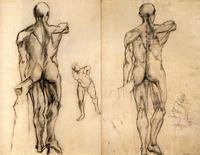
L'Ecorche and Borghese Gladiator
Vincent van Gogh
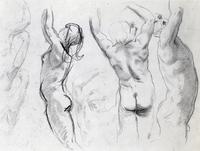
Studies of a Nude Youth
John Singer Sargent
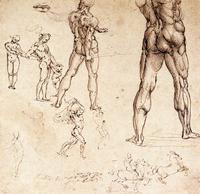
Anatomical studies
Leonardo da Vinci
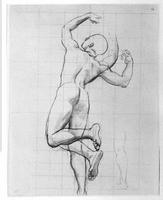
Drawing 6
John Singer Sargent
Untitled
Craig Mullins
Bewegungsstudie II
Johannes Itten
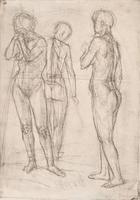
Kondor Béla, Három Akt
Kondor Béla
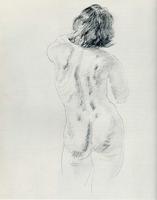
Nude standing
John French Sloan
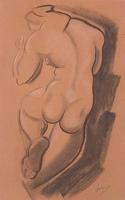
Nude Female Figure Shown from the Back
Olexandr Archipenko
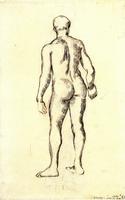
Idol
Vincent van Gogh
Idol
Vincent van Gogh
Mario Mancini
John Singer Sargent
Figure studies of a male youth
John Singer Sargent
Idol
Vincent van Gogh
The Model
Kuzma Petrov-Vodkin
Standing Male Nude
Vincent van Gogh
Kneeling Male Nude With Sprawled Out Arms, Male Torso
Gustav Klimt
Drawing 4
John Singer Sargent
Idol and Sketches of Venus
Vincent van Gogh
Etude des Hommes
Theophile Steinlen