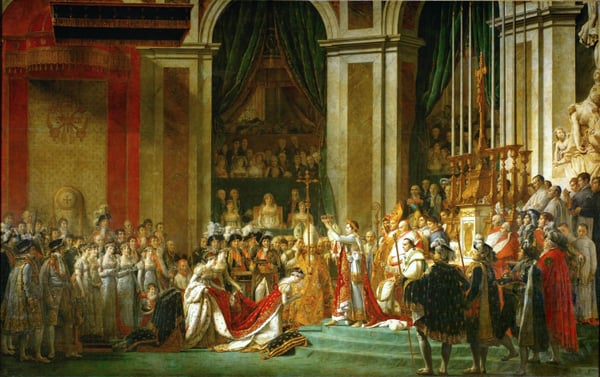
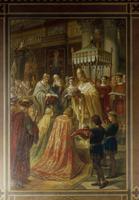
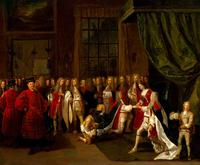
As an expert art historian, I will analyze The Consecration of the Emperor Napoleon and the Coronation of the Empress Josephine by Pope Pius VII, 2nd December 1804 by Jacques-Louis David using only the supplied structured facts: its style (Neoclassicism) and genre (history painting). These two elements are key to understanding the artwork’s significance.
Significance within Neoclassicism:
This painting is a quintessential example of Neoclassical principles applied to a contemporary political event. David, the leading Neoclassical painter of his era, employs the style’s hallmark traits: clear, linear composition; a frieze-like arrangement of figures; subdued color palette; and a focus on moral gravity and order. The scene is structured with geometric precision, emphasizing stability and rational clarity—values central to Neoclassicism. The figures are rendered with idealized, sculptural forms, and the lighting is even, avoiding dramatic Baroque shadows. This adherence to classical form elevates the coronation from a mere record to a timeless tableau of authority and ceremony.
Significance within the genre of history painting:
As a history painting, the work occupies the highest rank in the academic hierarchy of genres, intended to convey moral or national lessons. David transforms a specific political event—Napoleon’s coronation—into a monumental, edifying narrative. The composition captures the decisive moment of Josephine’s coronation, with Napoleon at the center (not the Pope), asserting his own power. This choice reflects the history painting’s capacity to shape collective memory and propaganda. By presenting the coronation as a sober, grand ritual, David legitimizes Napoleon’s reign while adhering to Neoclassical ideals of civic virtue and order. The painting also demonstrates the genre’s ambition to merge historical accuracy with idealization—a balance that made it one of the most celebrated state portraits of its time.
In sum, the artwork’s significance lies in how seamlessly it marries Neoclassical aesthetics with the authoritative functions of history painting, creating a visual document that is both artistically disciplined and politically potent.