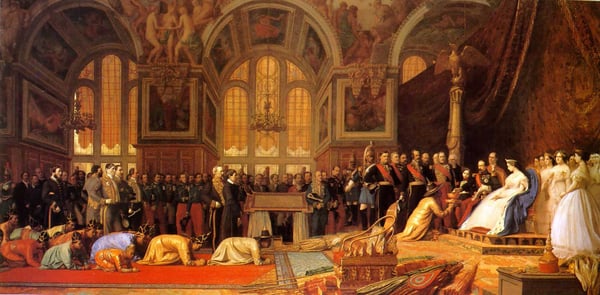
The Reception of Siamese Ambassadors by Emperor Napoleon III (1808-73) at the Palace of Fontainebleau, 27 June 1861
Details
Expert analysis of Jean-Leon Gerome’s The Reception of Siamese Ambassadors by Emperor Napoleon III (1808-73) at the Palace of Fontainebleau, 27 June 1861
Style: Academicism, Orientalism · Genre: history painting
This work is a prime example of how Jean-Léon Gérôme fused the rigorous techniques of Academicism with the exotic subject matter of Orientalism, a combination that made him one of the most celebrated—and later controversial—painters of the 19th century.
Significance within Academicism
As a staunch defender of the Académie des Beaux-Arts, Gérôme elevates a contemporary diplomatic event into a timeless, almost theatrical spectacle. The composition is meticulously balanced: the axis of the room draws the eye directly to the kneeling Siamese ambassadors, while Napoleon III and Empress Eugénie form a static, regal counterpoint. Gérôme’s use of linear perspective and lucid, enamel-like finish demonstrates his mastery of the academic ideal—every detail of architecture, costume, and jewel is rendered with photographic precision, yet the scene remains idealized and stately. This reflects the Academic belief that history painting should ennoble its subject through clarity and order.
Significance within Orientalism
Gérôme was a key figure in Orientalism, and here he turns the lens on diplomacy rather than the more typical harem or bazaar scenes. The Siamese delegates—in their pointed hats, elaborate silks, and prostrated posture—are depicted with ethnographic exactitude, yet they are also exoticized as objects of European curiosity. The painting documents a real event (the 1861 Siamese embassy to France) but frames it as a visual triumph of Western power. The contrast between the fluid, ornate costumes of the ambassadors and the stiff, European military uniform of Napoleon III reinforces a hierarchical gaze: the Orient is ornate, submissive, and fascinating; the West is disciplined, orderly, and dominant.
Why It Matters
This painting is historically significant as a state portrait of imperialism—France under Napoleon III was expanding influence in Southeast Asia (leading to the colonization of Cochinchina). Gérôme captures the moment when two worlds meet, but entirely on European terms, in the opulent Palace of Fontainebleau. It also exemplifies the tension in Gérôme’s career: celebrated in his time for technical brilliance, later criticized for reinforcing colonial stereotypes. As a historian of style, one can admire the flawless academic execution while recognizing the political narrative it serves—making this work a fascinating artifact of 19th-century European power, fantasy, and artistic ambition.
Museum / Gallery
Visually similar
20 works with related composition and palette
The Consecration of the Emperor Napoleon and the Coronation of the Empress Josephine by Pope Pius VII, 2nd December 1804
Jacques-Louis David
Marriage of D. Pedro and D. Amélia
Jean-Baptiste Debret
The Oath of the Cortes of Cádiz
José María Casado del Alisal
Louis XVIII Relevant La France De Ses Ruines
Louis-Philippe Crépin
Louis Xviii Relevant La France De Ses Ruines
Louis-Philippe Crépin
Cardinal Mazarin Dying
Paul Delaroche
Katherine of Aragon Denounced Before King Henry Viii and His Council
Laslett John Pott
Inauguration of the Reichstag
Anton von Werner
Vows John Kaz
Jan Matejko
King Philip V of Spain Making Marshal James Fitzjames
Jean Auguste Dominique Ingres
Juan de Austria's presentation to Emperor Carlos V in Yuste
Eduardo Rosales
Napoleon III, Eugenie and their Son for Adoption Siamese Ambassadors (detail)
Jean-Leon Gerome
La reina Ana y los Caballeros de la Jarretera
Peter Angellis
Queen of Sheba Before Solomon
Nikolaus Knüpfer
Wedding of Nicholas II and Grand Princess Alexandra Fyodorovna
Ilya Repin
King Matthias Receives the Papal Legates
Gyula Benczur
The Sultan's concert
Charles-Andre van Loo (Carle van Loo)
Last Scene From Hamlet
Salvador Sánchez Barbudo
Nikita Pustosviat. Dispute on the Confession of Faith
Vasily Perov
Oath of the Army to the Emperor
Jacques-Louis David