Expert analysis of Jacques-Louis David’s The Death of Socrates
Style: Neoclassicism · Genre: history painting
Expert Analysis: "The Death of Socrates" by Jacques-Louis David
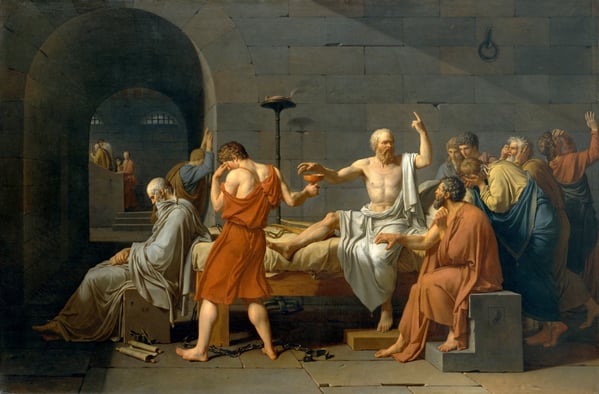
Jacques-Louis David’s The Death of Socrates stands as a definitive masterpiece of Neoclassicism—a style that revered the clarity, moral gravity, and formal rigor of Greco-Roman antiquity. Executed as a history painting, a genre then considered the highest in the academic hierarchy, the work elevates a philosophical martyrdom into a civic allegory for the Enlightenment era.
Significance within Neoclassicism:
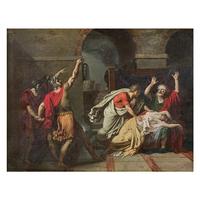
David epitomizes Neoclassical ideals through precise draftsmanship, balanced composition, and restrained emotional expression. The scene is set in a stark, shallow space—a prison cell—with figures arranged like a frieze, echoing classical bas-reliefs. Every gesture is deliberate: Socrates reaches for the hemlock cup with serene resolve, while his disciples react in varied poses of grief and devotion. The lighting is crisp and even, avoiding theatrical Baroque shadows, and the color palette relies on sober earth tones and clear local colors. This controlled clarity serves the Neoclassical goal of moral instruction over sensory spectacle.
Significance as a History Painting:
As a history painting, The Death of Socrates does not merely record an event; it exemplifies the genre's purpose: to teach virtue through exemplary sacrifice. David captures the moment before Socrates’ death, emphasizing his philosophical composure despite unjust condemnation. The composition highlights Socrates’ outstretched hand, pointing upward—a gesture of unwavering principle. Each figure—Plato at the foot of the bed, Crito gripping his knee, the weeping attendant—reinforces the narrative of reason triumphing over fear. By choosing a subject from classical history (based on Plato’s Phaedo), David aligns the painting with the Enlightenment’s valorization of reason, justice, and the individual’s moral duty, making the work profoundly significant as a political and ethical statement of its time.
Conclusion:
The Death of Socrates remains iconic for its flawless execution of Neoclassical tenets—order, clarity, and didactic purpose—while transcending its era as a timeless meditation on integrity. As a history painting, it transforms a philosophical anecdote into a universal lesson in courage, securing David’s role as the foremost painter of the Neoclassical movement.
Museum / Gallery
Visually similar
20 works with related composition and palette
The Magnanimity of Lycurgus
Jean-Jacques-Francois Le Barbier
Cleombrotus Ordered into Banishment by Leonidas II, King of Sparta
Benjamin West
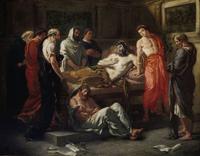
Last Words of the Emperor Marcus Aurelius
Eugene Delacroix
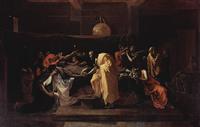
Extreme Unction
Nicolas Poussin
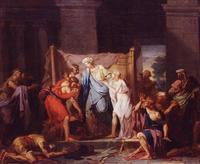
Scene
Charles Meynier
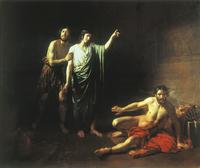
Joseph interpreting dreams to butler and baker, concluded with him in prison
Alexander Ivanov
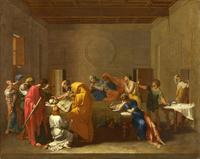
Extreme Unction
Nicolas Poussin
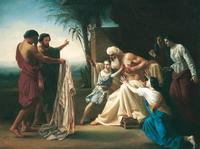
Jacob receiving Joseph's bloody coat
William-Adolphe Bouguereau
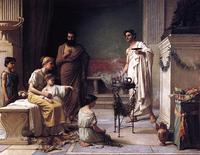
The Visit of a Sick Child to the Temple of Aesculapius
John William Waterhouse
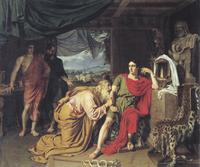
Priam Begging Achilles for Hector's Body
Alexander Ivanov
St. Peter, after his delivery from prison by the angel
William-Adolphe Bouguereau
Scipio's moderation
Vincenzo Camuccini
Pylades and Orestes Brought as Victims before Iphigenia
Benjamin West
Wamba Renunciando a La Corona
Juan Antonio Ribera

Saint Paul Bitten by a Viper
Cornelis Troost
Erasistratus the Physician Discovers the Love of Antiochus for Stratonice
Benjamin West
The death of Virginia
Vincenzo Camuccini
The Meeting of the Gauls in Reims
Otto van Veen
Oedipus Bids Farewell to Jocasta (study)
Alexandre Cabanel
MORT DE LUCRECE
Jacques Réattu