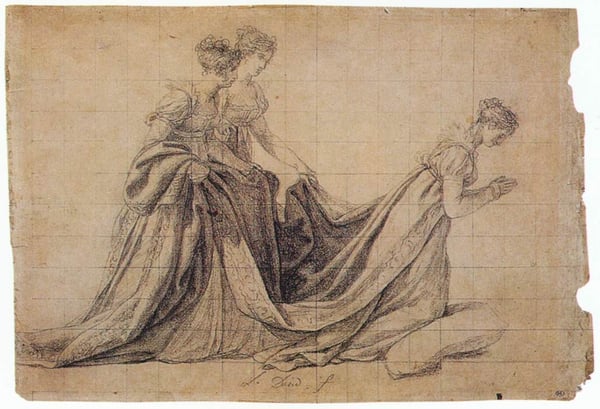
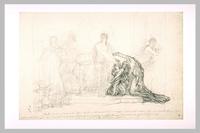
The Empress Josephine Kneeling with Mme de la Rochefoucauld and Mme de la Valett
Details
Expertenanalyse zu Jacques-Louis Davids The Empress Josephine Kneeling with Mme de la Rochefoucauld and Mme de la Valett
Stil: Neoclassicism · Genre: sketch and study
This sketch and study by Jacques-Louis David, The Empress Josephine Kneeling with Mme de la Rochefoucauld and Mme de la Valett, holds particular significance as a window into the artist’s neoclassical working method and his role as the official painter of Napoleon’s court.
Neoclassical Process and Purpose
Within Neoclassicism, preparatory studies were not mere rough drafts; they were disciplined investigations of form, composition, and moral clarity. David, the era’s leading exponent, used sketches to perfect the harmonious arrangement of figures and the precise drapery that conveyed virtue and gravitas. Here, the kneeling pose of Empress Josephine—a central figure in Napoleonic iconography—demonstrates the neoclassical emphasis on idealized, sculptural postures rooted in ancient Roman and Greek precedents. The study’s existence suggests that David was working out a larger, perhaps ceremonial composition, a common practice for history paintings that aimed to ennoble contemporary events through classical lens.
Historical and Courtly Context
The work’s significance also lies in its subjects. Josephine, as Empress, was a key figure in Napoleon’s self-made imperial mythology. By depicting her kneeling alongside two court ladies (Madame de la Rochefoucauld and Madame de la Valett), David engages with themes of loyalty, piety, and hierarchical grace—core values in neoclassical art that also served political propaganda. The sketch preserves a moment of intimate court ritual, revealing how David blended factual observation with idealized classicism. As a study, it offers an unfiltered glimpse into the artist’s compositional choices before they were refined into a finished, more solemn work.
Artistic Legacy
Finally, this sketch is significant for its rarity within David’s oeuvre. Most of his celebrated paintings are fully realized history scenes or portraits. This preparatory piece documents the step-by-step rationality of neoclassical design—the careful arrangement of figures, the fall of fabric, the balance of gesture—that underpins his monumental works. It reminds viewers that even the most polished neoclassical masterpieces began as disciplined, analytical studies, making this a valuable artifact for understanding both the artist’s process and the aesthetic ideals of his time.
Visuell ähnlich
20 Werke mit ähnlicher Komposition und Farbpalette
Erin Nuremberg and Venetian
Albrecht Durer
St. Agnes
Albrecht Durer
Two Venetian women
Albrecht Durer
Half figure of a woman holding out a flower
Giovanni Battista Piranesi
A Nuremberg Costume Study
Albrecht Durer
Portrait Of A Lady, Possibly Julia Jackson
George Frederick Watts
Kneeling woman
Rogier van der Weyden
Henriette Harvey and her half sister Elizabeth Norton
Jean Auguste Dominique Ingres
Virgin of the Annunciation
Matthias Grünewald
The Second Wise Virgin
Martin Schongauer
Pyrrhus and Andromache
Pierre-Narcisse Guerin
Personificaties Van De Vier Seizoenen (serietitel)
Henri Bonnart II
The Girl Squatted Down
Peter Paul Rubens
Three Studies of a Lady with a Hat
Antoine Watteau
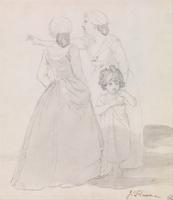
Two Women and a Child
John Flaxman
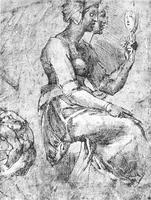
Study of a Seated Woman
Michelangelo
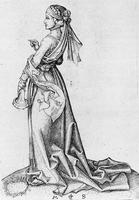
The First Foolish Virgin
Martin Schongauer
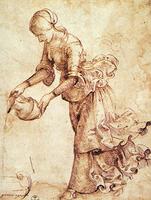
Study
Domenico Ghirlandaio
The Bower Meadow Study (Study of Dancing Girls)
Dante Gabriel Rossetti
Portrait of Frederik Carl Trant and His Wife Cornelia Née Schumacher 1770
Christian August Lorentzen