Expert analysis of Anthony van Dyck’s Charles I, King of England at the Hunt
Style: Baroque · Genre: portrait
This analysis focuses solely on the significance of Anthony van Dyck’s Charles I, King of England at the Hunt within the Baroque style and the portrait genre, based exclusively on the supplied facts.
Expert Analysis
Significance within Baroque Style and the Portrait Genre
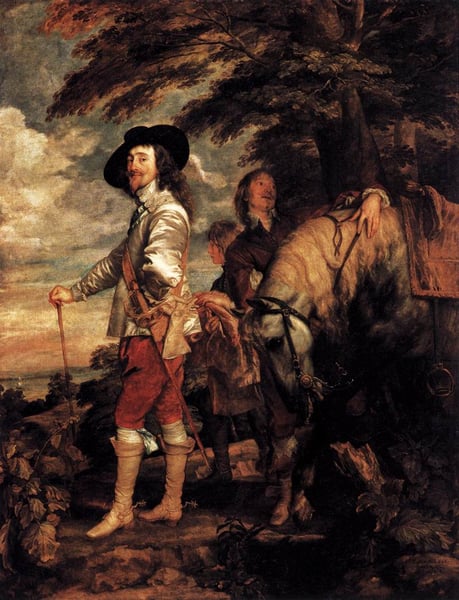
Van Dyck’s portrait of Charles I is a quintessential example of Baroque portraiture, distinguished by its ability to fuse royal authority with an air of effortless naturalism. Within the Baroque period—characterized by dramatic composition, rich color, and a pursuit of movement and emotional engagement—this work transcends the static conventions of earlier royal depictions.
The painting’s significance lies in its revolutionary approach to monarchical representation. Rather than presenting the king in formal, armor-clad rigidity, van Dyck captures Charles I in a relaxed hunting pose, set against a sweeping landscape. This choice is a hallmark of Baroque portraiture’s shift toward dynamism and psychological depth: the king appears both powerful and approachable, a “natural” ruler at ease in his domain. The composition—with the figure placed slightly off-center, the horse and attendants framing the scene, and the low horizon emphasizing the king’s stature—creates a sense of movement and grandeur typical of the Baroque.
Moreover, the work exemplifies the Baroque mastery of light and texture. Van Dyck’s handling of the silk, lace, and leather in Charles’s attire, combined with the soft, atmospheric lighting, introduces a tactile realism that elevates the portrait beyond mere documentation. This synthesis of informal elegance and regal symbolism made the painting a landmark in the evolution of the royal portrait, influencing generations of court painters. It stands as a testament to van Dyck’s ability to craft an image of sovereignty that is at once majestic and intimately human—a defining achievement of Baroque portraiture.
Museum / Gallery
Visually similar
20 works with related composition and palette
Charles I (after Anthony Van Dyck)
Thomas Stuart Smith
William Feilding 1st Earl of Denbigh
Anthony van Dyck
King Charles II on Humphrey Penderel's Mill Horse
Isaac Fuller
King Charles II in Boscobel Wood
Isaac Fuller
Militia Company of District VIII under the Command of Captain Roelof Bicker
Bartholomeus van der Helst
Charles II (1630–1685), and Nell Gwyn (1650–1687)
Edward Matthew Ward
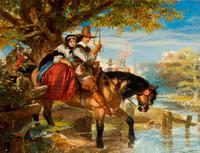
Charles II Assisted in His Escape by Jane Lane
Edward Matthew Ward
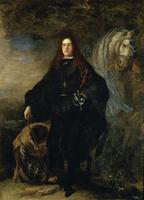
Portrait of the Duke of Pastrana
Juan Carreno de Miranda
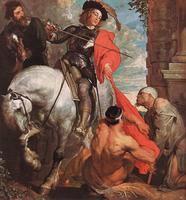
St Martin Dividing his Cloak
Anthony van Dyck
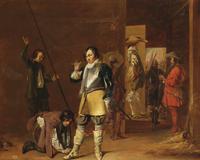
Call to Arms
Willem Cornelisz Duyster
Scene
Jacob Gerritsz Cuyp
A begging brother
Eduardo Zamacois
Portrait of Henri II de Lorraine, Duc de Guise
Anthony van Dyck
George Digby, 2nd Earl of Bristol and William Russell, 1st Duke of Bedford
Anthony van Dyck
Soldiers Fighting over Booty in a Barn
Willem Cornelisz Duyster
The Seducer
Antoine Watteau
Scene from Shakespeare's ‘Henry IV’, Part I
Marcellus Laroon the Younger
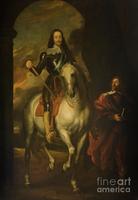
Charles I On Horseback
Anthony van Dyck
LANDSKNECHT VOR WINTERLICHER LANDSCHAFT
Anthonie Palamedesz.
Scene
Charles Nahl