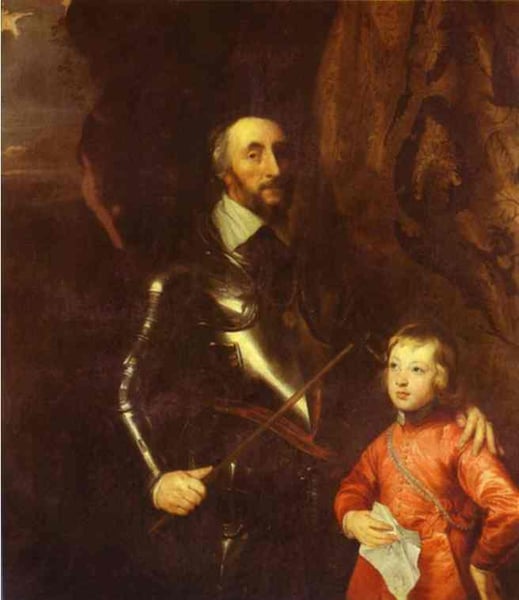
Thomas Howard, 2nd Earl of Arundel and Surrey with His Grandson Lord Maltravers
Ayrıntılar
Anthony van Dyck sanatçısının Thomas Howard, 2nd Earl of Arundel and Surrey with His Grandson Lord Maltravers eseri hakkında uzman analizi
Tarz: Baroque · Tür: portrait
Expert Analysis: Thomas Howard, 2nd Earl of Arundel and Surrey with His Grandson Lord Maltravers by Anthony van Dyck
This Baroque portrait by Anthony van Dyck (c. 1635) is a masterful example of the artist’s mature style and a quintessential statement of aristocratic identity in the 17th century. Van Dyck, the preeminent portraitist of the Stuart court, transformed English portraiture by infusing it with a sense of refined elegance, psychological depth, and theatrical grandeur—qualities that define the Baroque approach to depicting power and lineage.
Significance within the Baroque Style:
The painting exemplifies key Baroque traits: dynamic composition, rich chiaroscuro, and a focus on the sitter’s status and inner life. The Earl’s relaxed yet authoritative pose, with his hand resting on a globe (symbolizing worldly knowledge and patronage), contrasts with the innocent gesture of his young grandson, Lord Maltravers, who reaches toward the viewer. This intergenerational pairing is a deliberate Baroque device to convey dynastic continuity—a central theme for the nobility. The richly rendered fabrics, soft flesh tones, and masterful handling of light on the Earl’s face and the boy’s curls demonstrate van Dyck’s virtuosity in creating textures that feel almost tangible.
Art-Historical Context:
The subject, Thomas Howard (1586–1646), was a celebrated art collector and patron—known as the “Father of Vertu in England”—whose passion for Renaissance and Baroque art shaped the taste of the era. Van Dyck’s portrayal not only flatters the Earl’s intellect and grandeur but also immortalizes the Howard family legacy. The inclusion of the grandson underscores the Earl’s role as a patriarch, while the painting itself functioned as a public declaration of status, lineage, and cultural sophistication. This work stands as a paradigm of van Dyck’s influence: he elevated the portrait genre to a form of historical and dynastic narrative, blending Baroque drama with an intimate human connection that remains unequaled.
Görsel olarak benzer
İlişkili kompozisyon ve renk paletine sahip 20 eser
Portrait of a Member of the Balbi Family
Anthony van Dyck
The Lomellini Family
Anthony van Dyck
Portrait of Alof de Wignacourt and his Page
Caravaggio
Portrait Of George Hay, 2nd Earl Of Kinnoull
Anthony van Dyck
Portrait of a Man in Armor
Anthony van Dyck
Portrait of a Young General
Anthony van Dyck
Portrait of a Man (wrongly said to be Sir Thomas Chicheley, 1618–1699)
John Hayls
Portrait of Charles I King of England
Anthony van Dyck
Portrait of the Princes Palatine Charles Louis I and his Brother Robert
Anthony van Dyck
Allegorical Portrait of Charles II of England When Prince of Wales
William Dobson
Francesco I De Medici
Alessandro Allori
Thomas Wentworth, 1st Earl of Strafford in an Armor
Anthony van Dyck
PORTRAIT DES CHARLES DU HAN DE MARTIGNY ALS KOMMANDANT
Constantijn Netscher
Portrait Of Frederik Hendrik
Anthony van Dyck
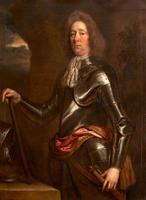
Sir John Carew
John Riley
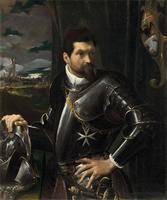
Portrait of Carlo Alberto Rati Opizzoni in armour three-quarter-length wearing the Order of the Knights of Malta the city of Bologna beyond
Ludovico Carracci
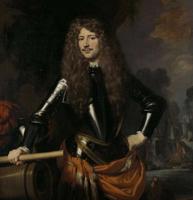
Cornelis Evertsen (1642 - 1706), Lieutenant Admiral of Zeeland
Nicolaes Maes
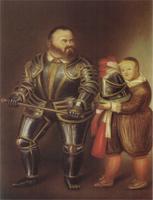
Alof of Vignancourt (after Caravaggio)
Fernando Botero
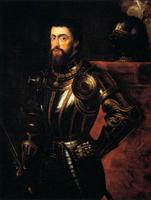
Charles V in Armour
Peter Paul Rubens
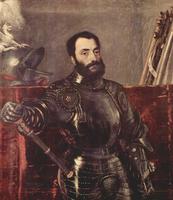
Portrait of Francesco Maria della Rovere
Titian