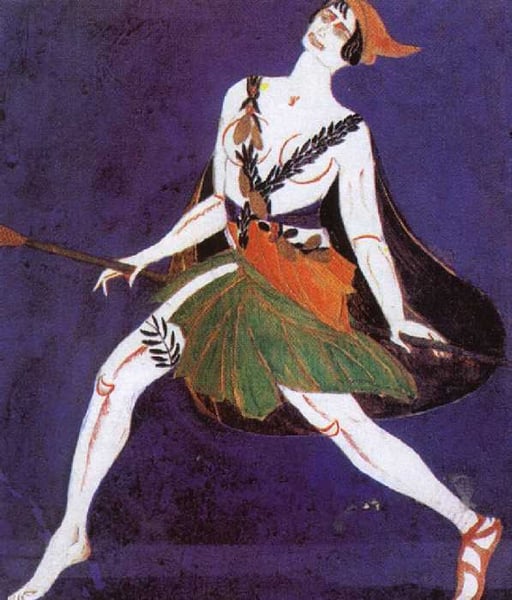
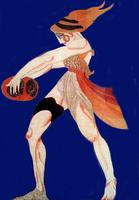
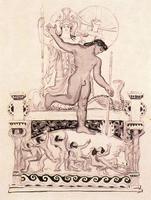
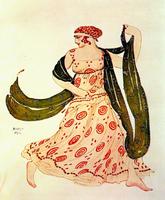
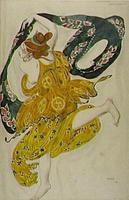
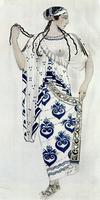
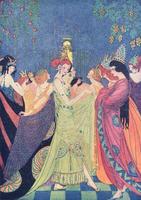
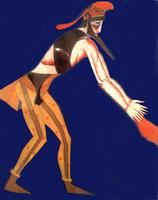
Aleksandra Ekster’s Costume Design for the play “Famira Kifared” by Innokentiy Annenski. Maenad is a striking example of how Art Nouveau’s decorative elegance was adapted for modernist theatrical design. While the work belongs to the Art Nouveau (Modern) style, Ekster infuses it with proto-Constructivist energy, reflecting her role as a bridge between fin-de-siècle ornament and the avant-garde.
The significance lies in her radical reinterpretation of the Maenad—a frenzied follower of Dionysus from Greek mythology. Instead of a classical or naturalistic portrayal, Ekster abstracts the figure into a dynamic pattern of swirling lines and bold, asymmetrical color blocks. The costume combines flowing, sinuous Art Nouveau curves (typical of the era’s emphasis on organic forms) with sharp, geometric cutouts and rhythmic repeats, suggesting motion and ritual ecstasy. This synthesis anticipates the geometric abstraction and stage dynamism that would define Russian Constructivism.
Ekster’s design is also notable for its functional innovation in theatre: the costume is not merely decorative but engineered for movement, emphasizing the performer’s body as a kinetic sculptural element. Her work for Annenski’s 1906 symbolist play (revived in 1916 with her designs) helped redefine costume as an expressive, abstract language—one that could evoke mythological archetypes through modern, non-representational means. This piece thus marks a pivotal moment where Art Nouveau’s decorative grace meets the avant-garde’s drive toward abstraction, making it a significant precursor to 20th-century modernist stage design.