Expert Analysis: "Costume Design for the play 'Famira Kifared'" by Aleksandra Ekster
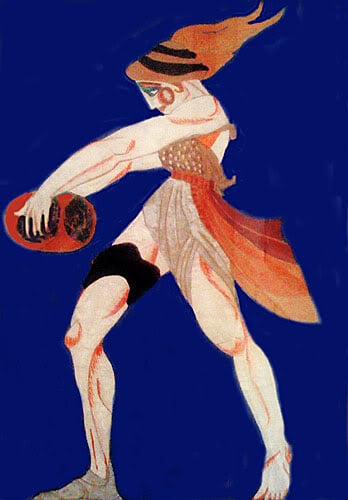
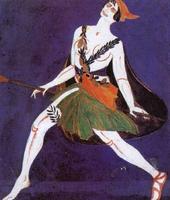
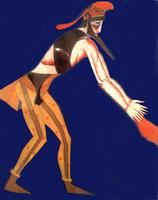
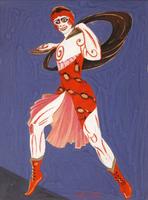
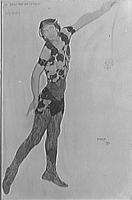
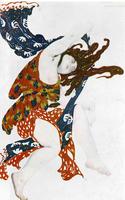
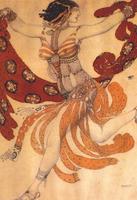
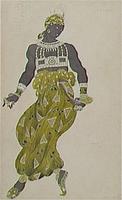
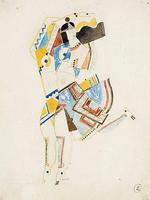
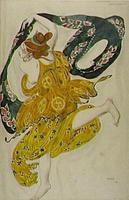
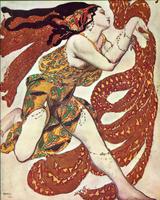
Aleksandra Ekster’s costume design for Famira Kifared (1916) is a striking example of Cubo-Futurist stagecraft, merging the geometric fragmentation of Cubism with the dynamic energy of Futurism. The work’s significance lies in its radical reimagining of theatrical costume as an abstract, sculptural element rather than a mere period garment. Ekster reduces the human figure to a composition of angular planes, sharp diagonals, and vivid color blocks, creating a sense of motion and tension that aligns with the play’s mythological subject—the tragic story of the Thracian musician Famira.
This design pushes beyond traditional illustration into a new genre of “costume-as-architecture,” where fabric mimics industrial or mechanical forms. The bold, non-naturalistic palette and rhythmic lines evoke the Futurist obsession with speed and modernity, while the Cubist faceting challenges perspective and spatial logic. For Ekster, costume was not just clothing but an extension of the actor’s performance, transforming the stage into a living abstract composition. Her work here anticipates Constructivist stage designs and remains a pivotal bridge between fine art and performance—a testament to Cubo-Futurism’s belief in art as an active, immersive force.