
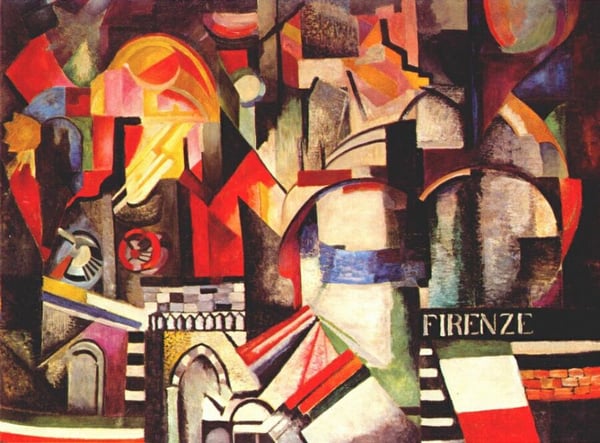
Expert analysis of Aleksandra Ekster’s Florence
Style: Cubo-Futurism · Genre: cityscape
Expert Analysis of "Florence" by Aleksandra Ekster
Aleksandra Ekster’s Florence stands as a compelling synthesis of Cubist structure and Futurist dynamism—hallmarks of the Cubo-Futurist style she helped pioneer within the Russian avant-garde. As a cityscape, the work transforms the historic Italian city into a vibrating grid of angular planes and intersecting lines, capturing not a static view but the modern energy of urban space.
Significance within Cubo-Futurism
Cubo-Futurism emerged as a radical fusion: from Cubism it borrowed the fragmentation of objects into geometric facets and multiple perspectives; from Futurism it took the celebration of speed, technology, and the simultaneity of experience. In Florence, Ekster applies these principles to a classical subject, deconstructing architecture—domes, facades, towers—into shards of color and shadow that seem to collide and recede simultaneously. The composition avoids a single vanishing point, instead creating a rhythmic, almost musical arrangement of forms that pushes the eye across the canvas.
Role of the Cityscape Genre
By choosing Florence—a city synonymous with Renaissance harmony—Ekster performs a deliberate avant-garde gesture: she reinterprets tradition through a modern lens. The city’s iconic silhouette becomes a laboratory for exploring how space and time can be rendered as a dynamic, fractured whole. Unlike purely abstract works, the city genre here retains a recognizable subject, grounding the radical formal experimentation in a dialogue with art history.
Ekster’s Innovation
Ekster was unique in bringing a theatrical sense of color and rhythm to Cubo-Futurist painting. Florence likely employs bright, non-naturalistic hues (typical of her palette) to heighten the sense of motion and emotional intensity. Her background in stage design also surfaces in the work’s sense of constructed space—each geometric plane feels like a set piece, orchestrating a drama of light and mass.
Why It Matters
This artwork exemplifies how Cubo-Futurism, though short-lived, provided a crucial bridge between French Cubism and later abstraction. Ekster’s Florence is not merely a record of a place but a manifesto: it declares that even the most storied city can be seen anew through the fragmented, accelerated vision of the modern age. It remains significant as a vivid document of a moment when artists dared to break the picture plane into a symphony of contradictions—static yet speeding, monumental yet dissolving.
Visually similar
20 works with related composition and palette

Stables
Franz Marc
Vanity Box
Kazimir Malevich

City at Night
Aleksandra Ekster

Pub (Auction)
Olga Rozanova

Memories of the Caucasus
Oleksandr Bogomazov

Picture with Cattle
Franz Marc
The factory and the bridge
Olga Rozanova
Kuřák
Emil Filla

The Traveler
Lyubov Popova
Living in a big hotel
Kazimir Malevich
King and Queen surrounded by swift nudes
Marcel Duchamp

Paysage
Albert Gleizes
Seated Figure
Lyubov Popova

Femmes cousant
Albert Gleizes
The lady at the piano
Kazimir Malevich

The Circus
Fernand Leger
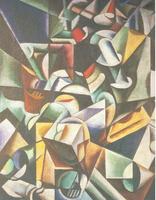
Female Model
Lyubov Popova
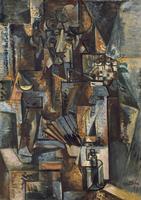
Žena S Vějířem
Emil Filla

Naked model in the workshop
Fernand Leger

Window opened to the street Penthieure
Pablo Picasso