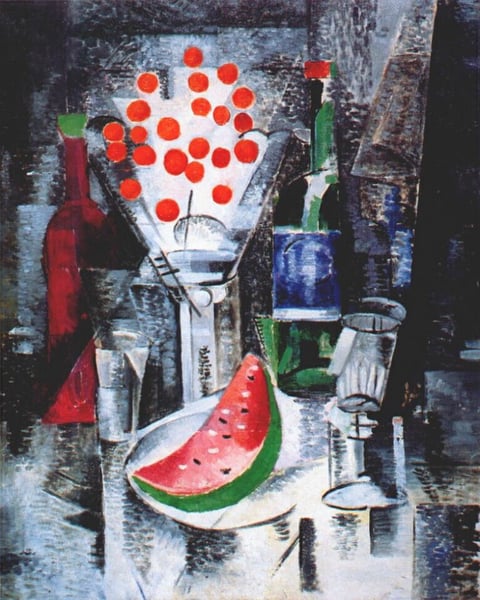
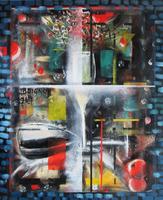
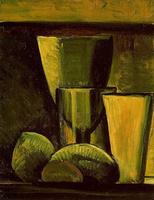
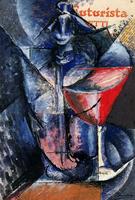
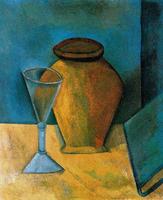
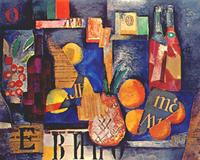
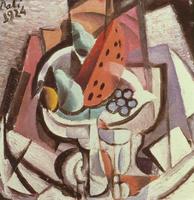
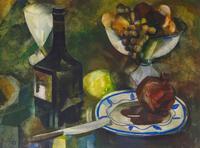
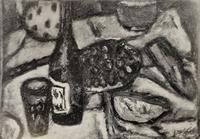
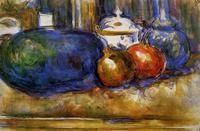
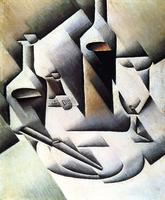
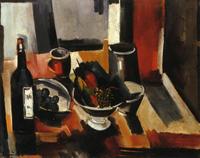
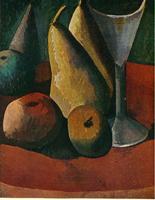
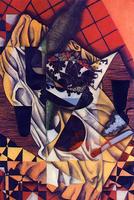
Aleksandra Ekster’s Still life, bowl of cherries exemplifies the core innovations of Cubo-Futurism, a style that fuses the geometric fragmentation of Cubism with the dynamic energy of Futurism. Despite the traditional still-life genre, the work breaks from static depiction: the bowl and cherries are dissected into angular facets and intersecting planes, while vibrant, contrasting colors and rhythmic lines create a sense of movement and vibration. This approach transforms a simple subject into a study of spatial relationships and temporal flux, challenging conventional representation. Ekster’s treatment elevates the still life into a dynamic, modernist composition that captures the Futurist obsession with speed and the Cubist drive to depict multiple viewpoints simultaneously—making it a significant example of how avant-garde artists reimagined everyday objects as vehicles for radical formal experimentation.