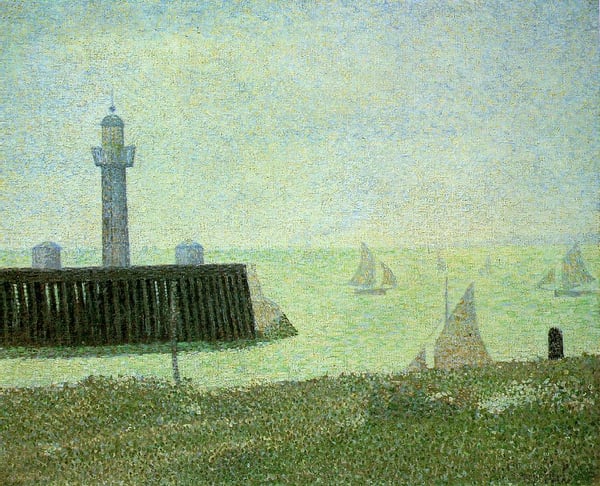
End of the Jetty, Honfleur
Подробности
Экспертный разбор работы «End of the Jetty, Honfleur» художника Georges Seurat
Стиль: Pointillism, Neo-Impressionism · Жанр: landscape
Georges Seurat's "End of the Jetty, Honfleur" (1886) stands as a pivotal example of Neo-Impressionism and the Pointillist technique, marking a radical departure from the spontaneous brushwork of Impressionism toward a more scientific, systematic approach to color and light.
Significance within Style and Period
-
Systematic Pointillism and Optical Mixing:
Unlike the intuitive, rapid strokes of the Impressionists, Seurat applied tiny, distinct dots of pure, unmixed pigment—blue, yellow, red, and green—directly onto the canvas. The viewer’s eye optically blends these dots at a distance, creating a luminous, vibrating effect that enhances the sense of atmosphere and light. In End of the Jetty, Honfleur, this method is particularly evident in the shimmering sky and the reflective surface of the water, where Seurat meticulously layers complementary colors (e.g., orange and blue) to heighten intensity. -
Scientific Color Theory:
Seurat was deeply influenced by contemporary color theories, especially those of Michel-Eugène Chevreul and Ogden Rood, which emphasized simultaneous contrast and the emotional impact of hues. Here, the cool blues and greens of the sea and sky are punctuated by warm touches of orange and pink in the sky and the jetty’s structure, creating a balanced yet dynamic composition. This calculated use of color anticipates later developments in modern art, from Fauvism to optical painting. -
Composition and Structure:
The painting depicts the jetty at Honfleur, a Normandy port popular with artists, but Seurat transforms the scene through rigorous composition. The horizontal bands of sea, sky, and shore are stabilized by the diagonal thrust of the jetty and the vertical accents of the masts and figures. This geometric order reflects Seurat’s interest in balancing nature with classical harmony, a hallmark of Neo-Impressionism that contrasts with the fleeting, informal snapshots of Impressionism. -
A Bridge Between Impressionism and Modernism:
While the subject—a coastal landscape—is typical of Impressionism, Seurat’s execution is analytical and detached. The dots eliminate individual brushstrokes, removing the artist’s personal touch and emphasizing the painting as a constructed, almost mechanized image. This foreshadows the abstraction and objectivity of 20th-century movements such as Post-Impressionism and even early abstraction in artists like Mondrian and Kandinsky. -
A Marine Masterpiece in Seurat's Oeuvre:
Painted during the summer of 1886, End of the Jetty, Honfleur is among Seurat’s most accomplished seascapes. It exemplifies his ability to capture the subtle variations of maritime light—the haze of a humid afternoon, the soft reflection of clouds, and the calm rhythm of the tide—all through a grid of precise color dots. This work, along with A Sunday on La Grande Jatte (1884–86), solidified Seurat’s reputation as the leader of the Neo-Impressionist movement.
In summary, "End of the Jetty, Honfleur" is not merely a landscape but a manifesto of Pointillist principles: a fusion of scientific color theory, deliberate structure, and a new way of seeing that redefined landscape painting in the late 19th century. Its significance lies in its rigorous application of technique to convey atmosphere, marking a critical step toward the abstraction and formal experimentation of modern art.
Museum / Gallery
Визуально похожие
20 работ с близкой композицией и палитрой
Trouville, the Jetty and the Basin
Eugene Boudin
Port-en-Bessin Entrance to the Harbor
Georges Seurat
Race in Grandcamp
Georges Seurat
Le Haver, the Port Entrance
Othon Friesz
Trouville, the Jettys, Low Tide
Eugene Boudin
Trouville. The Jettys Low Tide.
Eugene Boudin
Trouville. The Jettys Low Tide.
Eugene Boudin
The Channel at Gravelines, in the Direction of the Sea
Georges Seurat
Harbor Entrance Ostend
Alfred William Finch
The Port of Trouville
Eugene Boudin
The Jetties, Low Tide, Trouville
Eugene Boudin
Seascape
Ioannis Altamouras
Paysage
Jean Metzinger
Beach at Sainte-Adresse
Frederic Bazille
Back to Fishing boats in Belle-Isle-en-Mer
Maxime Maufra
Port of Honfleur
Georges Seurat
The Jetty, Le Havre, High Tide, Morning Sun
Camille Pissarro
The Jetties, Low Tide, Trouville
Eugene Boudin
The pilot's jetty, Le Havre
Camille Pissarro
Entrance to the Port of Trouville
Claude Monet