Expert analysis of Eugene Boudin’s The Port of Trouville
Style: Impressionism · Genre: landscape
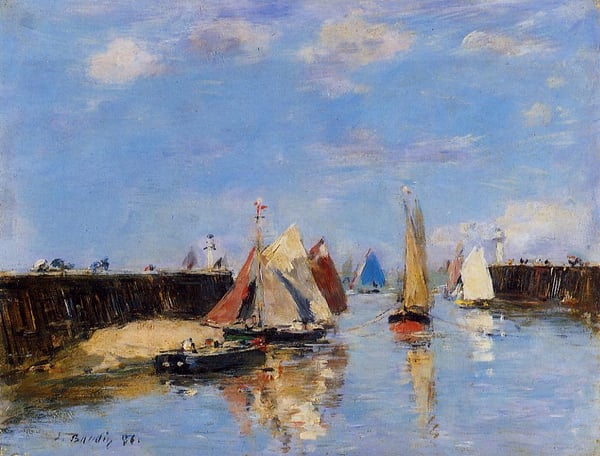
Expert Analysis: "The Port of Trouville" by Eugène Boudin
As an Impressionist landscape, The Port of Trouville exemplifies Eugène Boudin’s pioneering role in capturing the fleeting effects of light and atmosphere directly from nature—a practice that profoundly influenced the development of the Impressionist movement. Painted en plein air, the work records the bustling Norman port with a spontaneous, sketch-like freshness that anticipates the later innovations of Monet and his circle.
Significance within Impressionism and the Landscape Genre:
-
Precursor to Impressionist Aesthetics – Boudin’s emphasis on the shifting qualities of sky, water, and air places this work at the very threshold of Impressionism. The loose, visible brushwork and the muted yet luminous palette convey the moist, ever-changing coastal light, making the atmosphere itself the true subject rather than a mere backdrop.
-
Capture of Modern Leisure and Commerce – The Port of Trouville was a popular seaside resort in the mid-19th century, frequented by Parisian vacationers. In this painting, Boudin merges the traditional landscape genre with a contemporary scene of leisure and maritime activity—fishing boats, promenading figures, and dockside bustle—revealing the interplay between nature and modern life that would become a hallmark of Impressionist subject matter.
-
Structural Innovation – Unlike the tightly finished landscapes of the Barbizon School, Boudin’s composition relies on a high horizon line and broad horizontal bands of sand, sea, and sky. This flattened perspective, combined with rapid strokes and thin washes of color, prioritizes the overall sensation of the moment over meticulous detail, challenging academic conventions of landscape painting.
-
Influence on Claude Monet – Boudin famously mentored the young Monet, urging him to paint outdoors and to “study the sky, the light.” The Port of Trouville embodies this teaching. Its shimmering reflections and atmospheric haze directly prefigure Monet’s own depictions of the Normandy coast, cementing Boudin’s role as a crucial bridge between Realism and Impressionism.
In sum, The Port of Trouville is significant not only as a masterful Impressionist landscape but as a foundational work that helped redefine how artists perceive and represent light, atmosphere, and the transient rhythms of the modern world.
Museum / Gallery
Visually similar
20 works with related composition and palette
Trouville. The Jettys Low Tide.
Eugene Boudin
Trouville, the Jetty and the Basin
Eugene Boudin
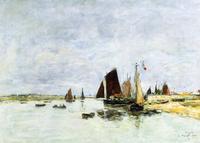
Etaples, Boats in Port
Eugene Boudin
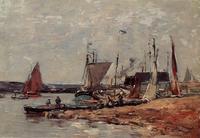
Trouville, the Port
Eugene Boudin
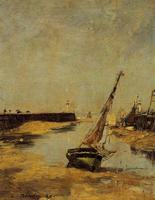
Trouville, the Jettys, Low Tide
Eugene Boudin
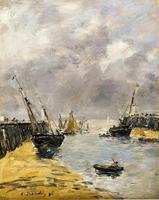
The Jetties, Low Tide, Trouville
Eugene Boudin
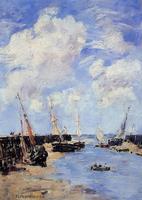
Trouville, the Jettys, Low Tide
Eugene Boudin
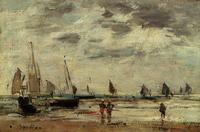
Berck, Jetty and Sailing Boats at Low Tide
Eugene Boudin
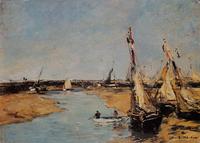
Trouville, the Jettys at Low Tide
Eugene Boudin
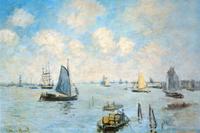
The Sea at Amsterdam
Claude Monet
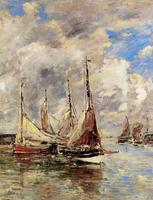
Trouville. The Jettys High Tide.
Eugene Boudin
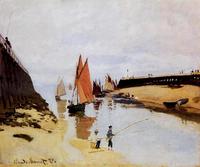
Entrance to the Port of Trouville
Claude Monet
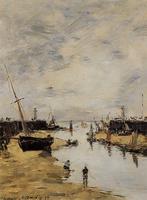
Trouville. The Jettys Low Tide.
Eugene Boudin
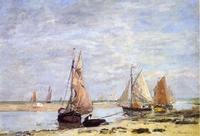
Sailboats near Trouville
Eugene Boudin
Port De Rotterdam
Maximilien Luce
The Inner Port and Pilots Jetty, Havre
Camille Pissarro
High Tide at Trouville
Eugene Boudin
Sailing Boats at Honfleur
Claude Monet
Deauville, the Jetty
Eugene Boudin
The Lock at Trouville
Eugene Boudin