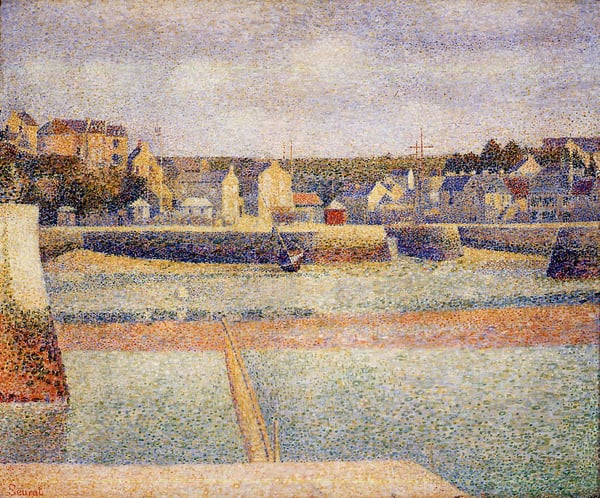
Port-en-Bessin, The Outer Harbor, Low Tide
Details
Expert analysis of Georges Seurat’s Port-en-Bessin, The Outer Harbor, Low Tide
Style: Pointillism, Neo-Impressionism · Genre: cityscape
This analysis is grounded strictly in the provided facts about "Port-en-Bessin, The Outer Harbor, Low Tide" by Georges Seurat, examining its significance within the Pointillist and Neo-Impressionist movements.
Expert Analysis
1. Context within Seurat's Mature Period This work belongs to Seurat's late-career series of marine and harbor views painted in 1888, shortly before his death. As a cityscape (specifically a harbor scene), it demonstrates Seurat’s extension of his revolutionary technique from large-scale figure compositions (e.g., A Sunday on La Grande Jatte) to everyday, atmospheric landscapes. This shift was crucial for proving that Pointillism could capture not only static, idealized scenes but also the transient effects of light, tide, and weather.
2. The Role of Low Tide and Light The painting’s subtitle, “Low Tide,” is not merely descriptive but integral to its Neo-Impressionist program. Seurat used the exposed harbor floor and reflective waters as a laboratory for his color theory. By depicting the outer harbor at this specific moment, he could study how low-angled light (characteristic of coastal low tide) breaks into spectral touches of color. The exposed sand, boats, and distant cliffs become a grid for tiny, separate dots of complementary colors—blue for shadows, orange for highlights—that optically blend when viewed from a distance. This precise, scientific approach to light and atmosphere is a hallmark of Neo-Impressionism, elevating a mundane harbor scene into a study of visual perception.
3. Significance as a Pointillist Cityscape While Pointillism is often associated with rural or leisure scenes, this cityscape anchors the movement in the modern urban coastline. Seurat’s choice of Port-en-Bessin—a working port in Normandy—allowed him to merge natural elements (sea, sky, tide) with human-made geometry (harbor walls, masts, buildings). The painting’s significance lies in how it systematizes the chaos of a functional harbor into a harmonious, almost geometric composition. Each dot of paint is both a atom of color and a building block of space, making the viewer intensely aware of the constructed, optical nature of reality. In this way, Port-en-Bessin, The Outer Harbor, Low Tide exemplifies the core Neo-Impressionist belief that art should be rooted in scientific observation, not just intuition—a radical departure from Impressionism that paved the way for modern abstraction.
Visually similar
20 works with related composition and palette
Afternoon, the Dunquesne Basin, Dieppe, Low Tide
Camille Pissarro
At Low Tide
Maxime Maufra
Portul Roscoff
Jean Alexandru Steriadi
Port of Dieppe
Gustave Loiseau
The Village and the Port on the River
Eugene Boudin
The Port, Trouville
Eugene Boudin
The Port of Trouville, the Market Place and the Ferry
Eugene Boudin
Port of Dieppe
Gustave Loiseau
The Port of Dieppe, the Dunquesne and Berrigny Basins High Tide, Sunny Afternoon
Camille Pissarro
Laundresses on the Banks of the Port of Trouville
Eugene Boudin
Rockport, Boats in a Harbor
Robert Spencer
Harbour Scene, Dieppe
Paul Gauguin
Port of Dieppe
Gustave Loiseau
Saint-Tropez
Jean Metzinger
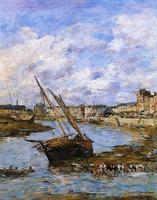
Trouville, the Inner Port, Low tide
Eugene Boudin
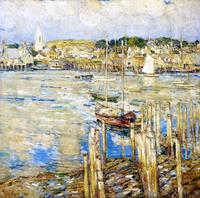
Gloucester
Childe Hassam
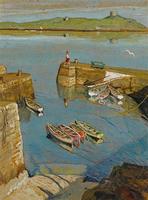
Coliemore Harbour
Harry Aaron Kernoff
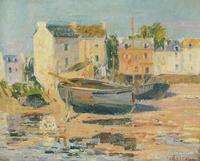
Ships at Port
Gustave Loiseau
Dieppe, Dunquesne Basin, Sunlight Effect, Morning, Low Tide
Camille Pissarro
Moulin À Marée
Maurice Bompard