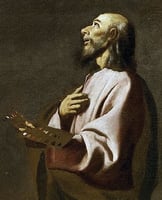
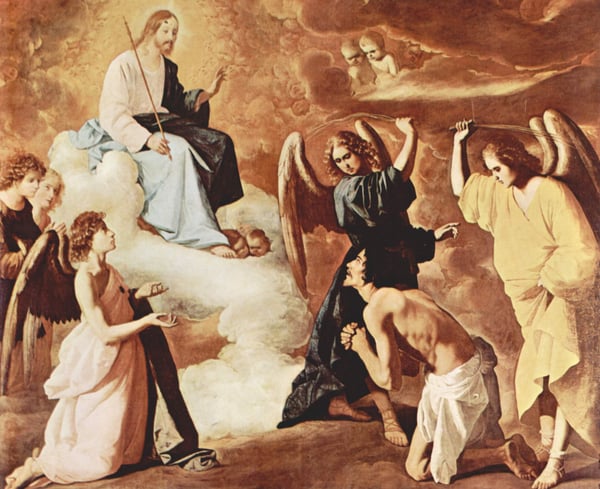
Flagellation of St. Jerome by the angels
Details
Expert analysis of Francisco de Zurbaran’s Flagellation of St. Jerome by the angels
Style: Baroque · Genre: religious painting
Expert Analysis: "Flagellation of St. Jerome by the Angels" by Francisco de Zurbarán
Francisco de Zurbarán’s Flagellation of St. Jerome by the Angels is a quintessential Baroque religious painting that distills the period’s preoccupation with spiritual intensity, dramatic chiaroscuro, and visceral emotional engagement. While the subject is relatively rare—St. Jerome is far more often depicted in his study or with a lion—Zurbarán seizes on an apocryphal moment of ascetic penance, wherein angels themselves administer the flagellation as a form of divine punishment or purification. This inversion of the usual angelic role (from comforter to chastiser) underscores the Counter-Reformation emphasis on penitence, suffering, and the triumph of faith through physical ordeal.
Style and Technique: Zurbarán’s mastery of tenebrism—a hallmark of Spanish Baroque—anchors the composition. A stark, directional light falls on Jerome’s muscular, aging torso, carving out every tendon and rib with almost sculptural precision. The background recedes into impenetrable darkness, focusing attention on the saint’s arched back and the angels’ implacable gestures. This stark contrast between light and shadow serves not only a dramatic function but also a spiritual one: the light signifies divine grace, even within suffering. The angels themselves are rendered with softer, more ethereal contours, their faces detached and impassive—neither cruel nor tender—which heightens the psychological tension.
Significance within Baroque Religious Painting: This work exemplifies the Baroque’s shift from idealized Renaissance harmony to raw, empathetic immediacy. Zurbarán specialized in isolated, monumental saints immersed in personal, often painful devotion. Here, the flagellation is not a historical narrative but a frozen instant of spiritual trial, inviting the viewer to meditate on sacrifice and redemption. The painting also reflects the Spanish Golden Age’s theological insistence on direct, sensory engagement with religious mysteries—an approach that served both liturgical and didactic purposes.
Moreover, the unusual choice to have angels wield the scourge amplifies the paradox of divine mercy and justice. By making the instrument of pain heavenly rather than human, Zurbarán elevates the scene from mere torture to a holy transaction: the saint’s flesh becomes the site of salvation. This theological nuance, combined with the artist’s signature realism and controlled emotion, secures the painting’s place as a compelling—if unsettling—masterpiece of Baroque religious art.
Visually similar
20 works with related composition and palette
Assumption of the Virgin
Orazio Gentileschi
Assumption of the Virgin
Juan del Castillo
Annunciation
El Greco
Ascension of Christ
Tintoretto
The Coronation of the Virgin
Guido Reni
The Annunciation
Bartolome Esteban Murillo
Le Christ au Mont des Oliviers
Jacob van Schuppen
Coronation of the Virgin
El Greco
Annunciation
El Greco
A Concert of Angels
Philippe de Champaigne
La Venida De La Virgen Del Pilar a Zaragoza
José Luzán
Coronation of the Virgin with Saints Joseph and Francis of Assisi
Giulio Cesare Procaccini
Vision of Blessed Alonso Rodriguez
Francisco de Zurbaran
Jacob's Dream
Raphael
Assumption of the Virgin
Juan de Valdes Leal
Abraham and the Three Angels
Giovanni Domenico Tiepolo
The Ascension of Our Lady
Giovanni Battista Gaulli
Assumption of the Virgin
Charles Le Brun
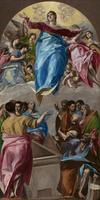
Assumption of the Virgin
El Greco
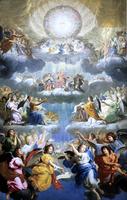
Les Neuf chœurs des Esprits célestes
Louis Licherie de Beurie