Analisi esperta di The Annunciation di Jan van Eyck
Stile: Northern Renaissance · Genere: religious painting
Expert Analysis: "The Annunciation" by Jan van Eyck
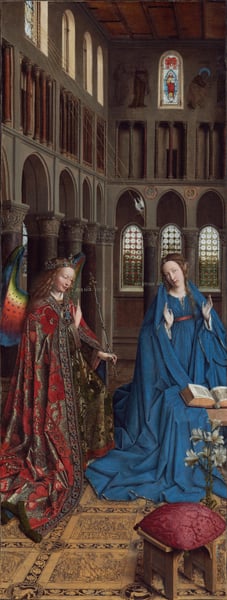
Jan van Eyck’s The Annunciation is a masterwork of the Northern Renaissance, distinguished by its revolutionary use of oil paint, meticulous naturalism, and layered symbolic complexity. Painted around 1434–1436, this religious scene transforms a familiar biblical moment into a profound meditation on the Incarnation, blending earthly realism with divine mystery.
Technical Innovation
Van Eyck’s virtuosic oil technique allowed him to achieve unprecedented luminosity and detail. The translucent glazes create a glowing, jewel-like surface—notice the shimmering folds of the Virgin’s blue robe and the metallic gleam of the angel Gabriel’s brocade vestments. Every element, from the polished floor tiles to the delicate light streaming through the window, is rendered with microscopic precision, exemplifying the Northern Renaissance fascination with observable reality.
Composition and Symbolism
The scene is set not in a humble Nazareth home but in a richly appointed Gothic church interior—a deliberate anachronism that conflates sacred history with contemporary devotion. The architecture functions as a symbolic framework: the Romanesque columns evoke the Old Law, while the Gothic windows hint at the New Covenant.
- Gabriel enters with a lily (purity) and a raised hand in blessing, his wings catching the divine light.
- Mary reacts with humble submission, her posture echoing traditional altar imagery. The book before her—open to Isaiah’s prophecy—“Behold, a virgin shall conceive” visually bridges Old and New Testaments.
- Dove and ray of light: The Holy Spirit descends along a golden beam, passing through the window without shattering the glass—a metaphor for Mary’s perpetual virginity.
Significance in Northern Renaissance
Van Eyck’s Annunciation epitomizes the period’s shift from symbolic abstraction to empirical observation. Unlike Italian contemporaries who idealized space, van Eyck creates a convincing, measurable room where light behaves naturally yet carries theological weight. The painting also reflects the burgeoning devotional practice of using tangible, beautiful objects to inspire spiritual contemplation—every brick, tile, and embroidered hem is a signatura rerum (signature of things) pointing to divine truth.
This work remains a touchstone for its seamless fusion of optical realism and intricate iconography, establishing van Eyck as the foremost pioneer of oil painting and a chronicler of the sacred in the mundane.
Museum / Gallery
Visivamente simili
20 opere con composizione e palette affini
The Virgin of the Chancellor Rolin
Jan van Eyck
St. Luke Drawing a Portrait of the Virgin Mary
Rogier van der Weyden
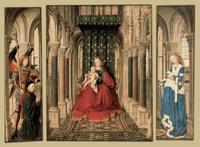
Dresden Triptych (Virgin and Child with St. Michael and St. Catherine and a Donor)
Jan van Eyck
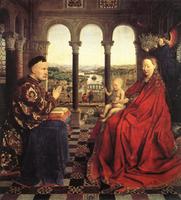
The Rolin Madonna (La Vierge au Chancelier Rolin)
Jan van Eyck
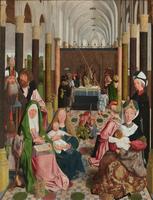
The Holy Kinship
Geertgen tot Sint Jans
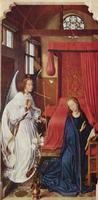
The Annunciation
Rogier van der Weyden
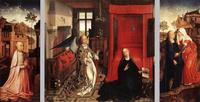
The Annunciation
Rogier van der Weyden
Virgin and Child Enthroned with two Musical Angels
Hans Memling
The Virgin and Child with Saints and Donor
Gerard David
The Annunciation
Bernard Van Orley
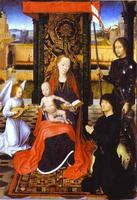
The Virgin and Child with an Angel, St. George and a Donor
Hans Memling
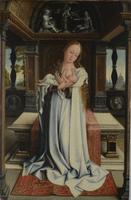
Virgin and Child
Bernard Van Orley
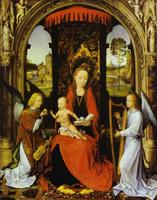
Madonna and Child with Angels
Hans Memling
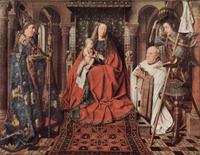
Madonna and Child with Canon Joris van der Paele
Jan van Eyck
The Virgin and Child with St. Anne
Defendente Ferrari
Saints Margaret and Apollonia
Rogier van der Weyden
The Annunciation ((Polyptych of the Virgin, the wing)
Dirk Bouts
Annunciation
Filippo Lippi
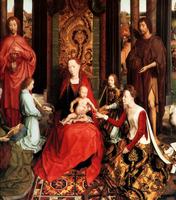
Triptych of the Mystical Marriage of St. Catherine of Alexandria, central panel: Marriage of St. Catherine
Hans Memling
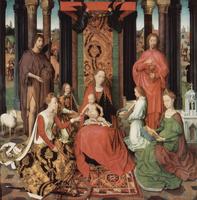
Central panel of the Triptych of St. John the Baptist and St. John the Evangelist
Hans Memling