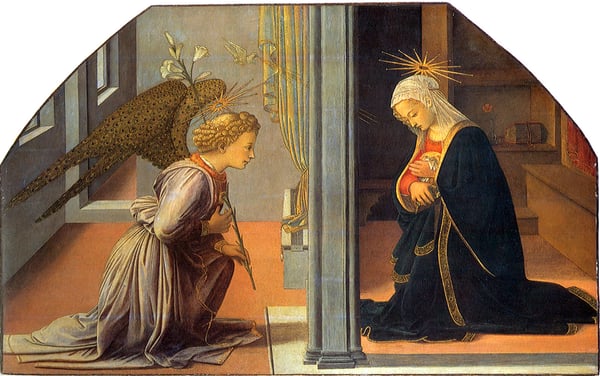
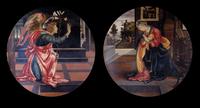
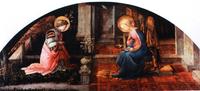
Filippo Lippi’s Annunciation stands as a quintessential example of Early Renaissance religious painting, distinguished by its harmonious blend of divine subject matter and humanized naturalism. Within the style’s broader move away from Gothic formalism, Lippi’s work achieves significance through its delicate balance of sacred narrative and intimate, earthly detail—a hallmark of the period’s evolving sensibility. The composition likely employs the era’s emerging linear perspective to structure the encounter between the angel and the Virgin, while Lippi’s characteristic soft modeling and lyrical line work infuse the scene with grace and approachability. This treatment not only reflects the Early Renaissance ambition to render spiritual events with convincing physical presence but also anticipates the more emotive, naturalistic religious art of later decades. Lippi’s Annunciation thus occupies a pivotal place in the period’s redefinition of devotional imagery, where technical innovation serves to deepen, rather than diminish, the viewer’s spiritual engagement.