Analisi esperta di The Offerings of Cain and Abel di Jan van Eyck
Stile: Northern Renaissance · Genere: religious painting
Expert Analysis: "The Offerings of Cain and Abel" by Jan van Eyck
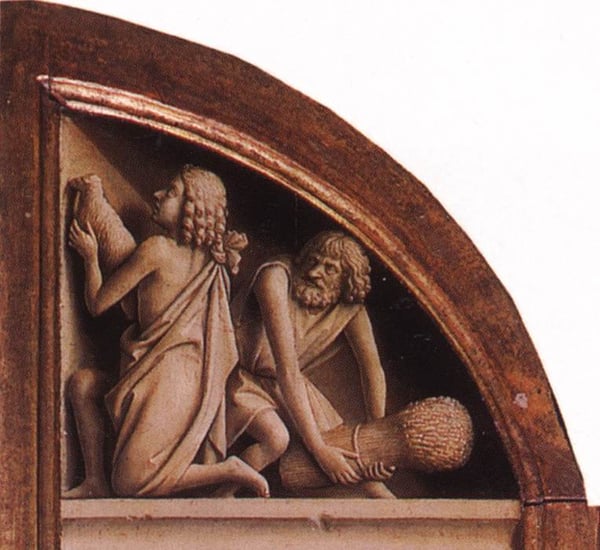
Jan van Eyck’s "The Offerings of Cain and Abel" stands as a masterful example of Northern Renaissance religious painting, demonstrating the period’s revolutionary technical and symbolic achievements. Though the subject is drawn from Genesis—depicting the first brothers presenting their sacrifices to God—van Eyck transforms this biblical narrative into a profound meditation on virtue, sin, and divine judgment.
Significance within the Northern Renaissance Style
Van Eyck’s work epitomizes the Northern Renaissance obsession with meticulous naturalism and symbolic depth. Every element—from the textures of the sacrificial offerings to the landscape’s minute detail—serves a dual purpose: verisimilitude and allegory. The use of oil glazes, a technique van Eyck perfected, allows for luminous, jewel-like colors and almost microscopic precision. In this painting, the sheen on Abel’s lamb contrasts with the dull, earthy tones of Cain’s sheaves, visually reinforcing the biblical contrast between acceptable and rejected offerings.
Religious and Symbolic Innovations
The painting’s significance lies in how it moralizes the scene through composition and gesture. Abel’s humble, upward gaze and open hands align with the Northern tradition of empathetic piety, while Cain’s clenched posture and averted face foreshadow his fratricidal jealousy. Van Eyck likely includes subtle iconography: the smoke from Abel’s fire rises straight to heaven, while Cain’s smoke disperses—a direct visual of God’s favor. The inclusion of a distant, serene Eden behind them underscores the fall from grace, a theme central to van Eyck’s theological caution.
Art Historical Impact
This work, while less known than van Eyck’s altarpieces, demonstrates his range in handling Old Testament subjects with the same psychological intensity as his portraits. It bridges the medieval tradition of typology (Cain and Abel as prefigurations of Christ and Judas) with the new humanist interest in individualized emotion. For its era, "The Offerings of Cain and Abel" is significant for marrying extreme naturalism with layered spiritual meaning, making it a quintessential artifact of the Northern Renaissance’s unique blend of the sacred and the tangible.
Museum / Gallery
Visivamente simili
20 opere con composizione e palette affini
The Ghent Altar (detail)
Jan van Eyck
The Ghent Altarpiece (exterior)
Jan van Eyck
The Annunciation
Jean Hey
The Cumaean Sibyl
Jan van Eyck
Triptych of Last Judgement
Hieronymus Bosch
The Ghent Altar (detail)
Jan van Eyck
The Annunciation
Jan van Eyck
Triptych of Adriaan Reins closed
Hans Memling
The Erythraean Sibyl
Jan van Eyck
Donor and St. John the Baptist
Jan van Eyck
Wings of the Kaisheim Altarpiece
Hans Holbein the Elder
Basilica San Paolo Fuori Le Mura
Hans Holbein the Elder
Basilica Santa Maria Maggiore
Hans Holbein the Elder
Scenes of the Life of St Nicholas
Ambrogio Lorenzetti
Triptych of Jan Floreins closed
Hans Memling
Resurrection and Descent of Christ into Limbo
Bartolome Bermejo
Altar of Saints John the Baptist and John the Evangelist
Hans Memling
Mary Altarpiece
Rogier van der Weyden
Christus Am Ölberg Und Die Marien Am Grabe
Lorenzo Monaco
Triptych The Pearl of Brabant. Left wing: St. John the Baptist, middle panel: Adoration of the Magi, right wing: St. Christopher
Dirk Bouts