Expert analysis of Hans Memling’s Altar of Saints John the Baptist and John the Evangelist
Style: Northern Renaissance · Genre: religious painting
Expert Analysis: Altar of Saints John the Baptist and John the Evangelist by Hans Memling
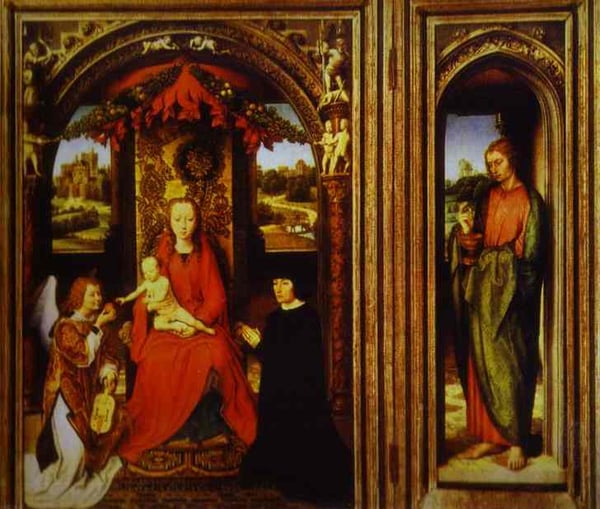
As a masterpiece of the Northern Renaissance, Hans Memling’s Altar of Saints John the Baptist and John the Evangelist embodies the period’s meticulous naturalism, symbolic complexity, and devotional intimacy. Painted in the late 15th century, this religious polyptych demonstrates Memling’s exceptional technical skill and his ability to synthesize the traditions of Early Netherlandish painting—particularly the influence of Rogier van der Weyden—with a graceful, harmonious clarity that became his hallmark.
Significance within its Style/Period:
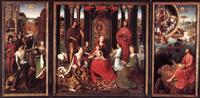
- Narrative and Symbolic Integration: The altarpiece combines scenes from the lives of the two John the Baptist and John the Evangelist, each saint associated with Christ’s revelation (Baptist as forerunner, Evangelist as visionary). Memling weaves their stories into a unified visual sermon, using the wings and central panel to juxtapose key episodes—such as the Baptism of Christ, the Beheading of John the Baptist, the Vision of Patmos, and the Evangelist’s martyrdom. This layered storytelling reflects the Northern Renaissance fascination with typology and sacred history.
- Technical Virtuosity: Memling’s oil painting achieves luminous, jewel-like color and razor-sharp detail—note the intricate brocades, translucent halos, and realistic landscapes. His handling of light models forms with a soft, atmospheric quality, while the meticulous depiction of textiles, flowers, and architectural elements demonstrates the Northern Renaissance’s commitment to empirical observation as a form of divine worship.
- Composition and Spatial Harmony: The altarpiece displays a balanced, almost symmetrical arrangement that guides the eye across the panels. Memling uses continuous landscape backgrounds to unify discrete scenes, a device that creates a coherent sacred space while allowing each narrative moment its own focus. This spatial unity, paired with his characteristic serene, idealized figures, lends the work a meditative stillness—inviting the viewer into contemplative prayer.
- Devotional Function: Originally created for a chapel or church, the altarpiece served both as liturgical focus and as an aid to personal piety. The saints’ calm, introspective expressions and the inclusion of donor portraits (often present in such works) reflect the Northern Renaissance emphasis on accessible, emotional spirituality—a faith made tangible through paint.
In short, this altarpiece stands as a quintessential example of the Northern Renaissance’s fusion of meticulous realism and profound symbolism. Memling’s serene yet richly detailed handling elevates the work beyond mere illustration, making it a lasting testament to the era’s belief that art could bridge the earthly and the divine.
Museum / Gallery
Visually similar
20 works with related composition and palette
Triptych
Hans Memling
Triptych of the Sedano Family
Gerard David
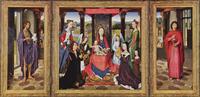
The Virgin and Child with Saints and Donors (The Donne Triptych)
Hans Memling
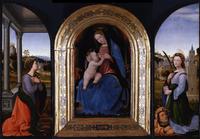
Triptych
Mariotto Albertinelli
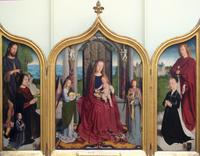
Triptych of the Sedano Family
Gerard David
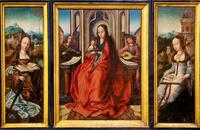
Virgin and Child, Saint Catherine and Saint Barbara
Quentin Matsys
Madonna of Humility with Angels and Donor
Filippo Lippi
Madonna and Child with Angels
Hans Memling
The Holy Family
Lucas Cranach the Elder
The Bourbon Altarpiece (The Moulins Triptych)
Jean Hey
Madonna with the Child
Petrus Christus
St. John Altarpiece
Hans Memling
Virgin and Child Enthroned with two Musical Angels
Hans Memling
Triptych of Camerino
Carlo Crivelli
Mary Altarpiece
Rogier van der Weyden
Quaratesi Altarpiece, Virgin and Child
Gentile da Fabriano
Enthroned Madonna
Carlo Crivelli
St. Ursula Shrine: Virgin and Child
Hans Memling
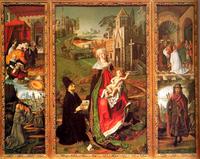
Saint Sebastian
Bartolome Bermejo
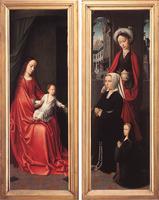
Triptych of Jan Des Trompes (rear of wings)
Gerard David