Expert analysis of Pietro Perugino’s Baptism of Christ
Style: Early Renaissance · Genre: religious painting
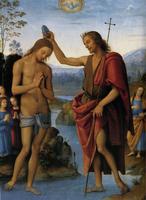
Expert Analysis: "Baptism of Christ" by Pietro Perugino
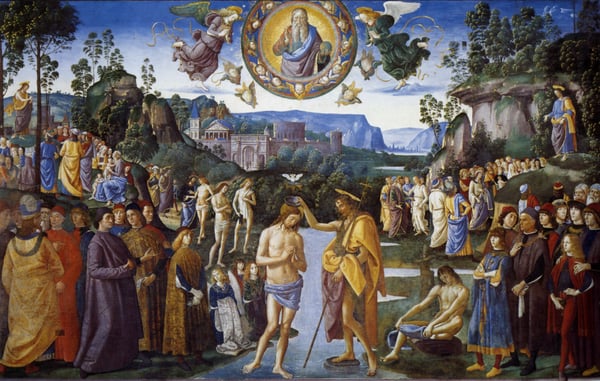
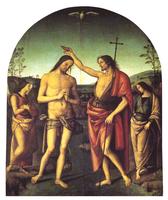
As a master of the Umbrian school and a pivotal figure in the Early Renaissance, Pietro Perugino’s Baptism of Christ exemplifies the period’s quest for harmonious clarity, balanced composition, and serene spiritual narrative. Painted during the late 15th century, this religious work is significant for its integration of linear perspective, naturalistic landscape, and a calm, idealized humanism that would directly influence his pupil, Raphael.
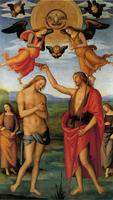
Composition and Spatial Harmony: Perugino organizes the scene around a central vertical axis formed by Christ and the dove of the Holy Spirit, flanked by John the Baptist and angels. The landscape—a soft, receding vista of hills, trees, and a winding river—employs atmospheric perspective, with cooler tones and hazier details in the distance, a hallmark of Early Renaissance spatial experimentation. The figures are arranged in a frieze-like balance, yet the subtle asymmetry of the angels’ poses and the gentle bend of the Jordan River introduce naturalistic movement.
Stylistic Significance: Perugino’s refined use of chiaroscuro (light and shadow) models the bodies with gentle transitions, avoiding harsh contrasts. The anatomical proportions are classical, but the figures’ graceful, almost lyrical gestures—St. John’s poised hand, Christ’s serene stance—prioritize spiritual tranquility over dramatic tension. This reflects the Early Renaissance ideal of decorum: sacred subjects rendered with clarity and dignity to inspire devotion.
Iconography and Period Context: The dove, halo, and open heaven emphasize the Trinity and Christ’s divine mission. The angels, holding Christ’s garments, reference the early Christian tradition of ritual preparation. Unlike the later High Renaissance’s dynamic complexity, Perugini’s Baptism embodies the Early Renaissance belief that art should reveal divine order through measured, beautiful order. The work’s enduring significance lies in its synthesis of naturalism, perspective, and pious serenity—a formula that defined Umbrian painting and paved the way for the monumental achievements of the 16th century.
Museum / Gallery
Visually similar
20 works with related composition and palette
Baptism of Christ
Pietro Perugino
Baptism of Christ
Domenico Ghirlandaio
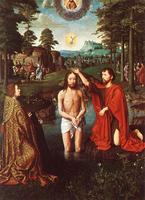
The Baptism of Christ (central section of Triptych of Jan des Trompes)
Gerard David
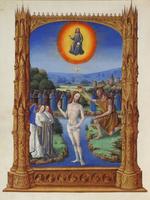
The Baptism of Christ
Limbourg brothers
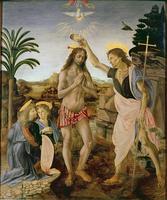
The Baptism of Christ
Leonardo da Vinci
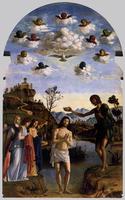
The Baptism of Christ
Cima da Conegliano
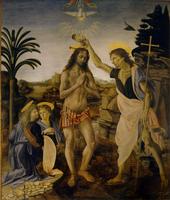
The Baptism of Christ
Andrea del Verrocchio
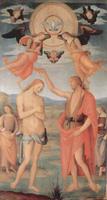
Altarpiece of St. Augustine - Scene Baptism of Christ
Pietro Perugino
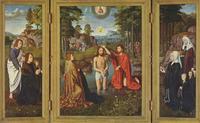
Triptych of Jan Des Trompes
Gerard David
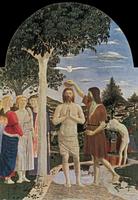
Baptism of Christ
Piero della Francesca
Law and Grace
Lucas Cranach the Elder
Baptism of Christ
Pietro Perugino
Polyptych of St. Peter (Resurrection)
Pietro Perugino
Pala di Sant Agostino (Baptism of Christ)
Pietro Perugino
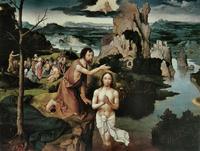
The Baptism of Christ
Joachim Patinir
Journey of Moses and circumcision of her second child
Pietro Perugino
The resurrection
Francesco Botticini
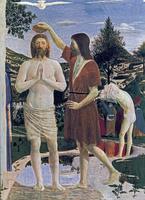
Baptism of Christ (detail)
Piero della Francesca
Baptism of Christ
Pietro Perugino
Moses's Journey into Egypt
Pietro Perugino