
Expert analysis of Pietro Perugino’s Baptism of Christ
Style: Early Renaissance · Genre: religious painting
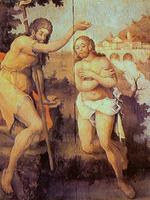
As an expert art historian, I will analyze Pietro Perugino’s Baptism of Christ based solely on the provided facts: it is an Early Renaissance religious painting. The significance of this work lies in how it epitomizes the core aesthetic and theological ideals of the Early Renaissance while remaining a quintessential example of its genre.
Artistic Significance within the Early Renaissance
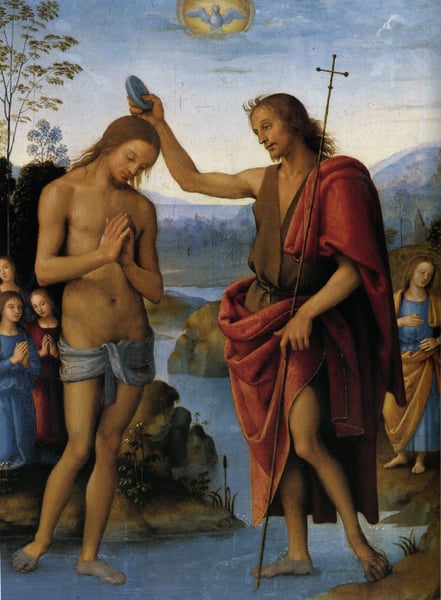
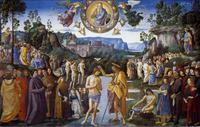
Perugino’s Baptism of Christ is a masterclass in the Early Renaissance principles of clarity, balance, and spatial harmony. The composition is symmetrical and serene, with the central figures of Christ and John the Baptist framed by a calm landscape that recedes into the distance. This use of linear perspective—a hallmark of the period—creates a convincing, orderly space that invites the viewer into a sacred narrative. The figures are placed in a shallow, frieze-like foreground, typical of Perugino’s work, which emphasizes their monumental dignity. The soft, diffused light and delicate color palette (often described as “Perugino blue” for the sky) create an atmosphere of lyrical spirituality, free from the dramatic tension of later Renaissance works. This serene, idealized treatment makes the painting a pure expression of humanist spirituality, where divine events are rendered with grace and accessibility.
Genre Significance (Religious Painting)
As a religious painting, Baptism of Christ achieves its significance through theological clarity. Perugino distills the biblical event into its most essential iconography: Christ at the center, John the Baptist pouring water over him, the dove of the Holy Spirit descending, and God the Father above (often symbolized by a radiant light or cloud). The landscape itself is not merely a backdrop but a symbolic Garden of Eden, echoing the purity of the baptismal moment. The still, measured gestures of the figures—Christ in prayerful devotion, John in reverent act—convey the sacrament’s solemnity without emotional excess. This painting sets a standard for devotional art that prioritizes contemplative calm, making it accessible for private piety or public altarpieces.
Why It Matters
Perugino’s Baptism is significant because it bridges the Gothic tradition of gold-ground icons and the naturalism of the High Renaissance. It demonstrates how Early Renaissance artists synthesized perspective, light, and human anatomy to make divine narratives tangible yet transcendent. Moreover, Perugino’s workshop model and his influence on a young Raphael are evident here: Raphael later credited Perugino’s balanced compositions and graceful figures as foundational to his own style. In this work, we see the Early Renaissance at its most confident—a period where art becomes a tool for both realistic observation and spiritual reflection.
Museum / Gallery
Visually similar
20 works with related composition and palette
Pala di Sant Agostino (Baptism of Christ)
Pietro Perugino
Baptism of Christ
Pietro Perugino
The Baptism of Christ
Andrea del Verrocchio
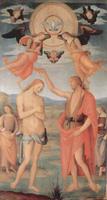
Altarpiece of St. Augustine - Scene Baptism of Christ
Pietro Perugino
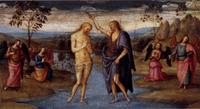
Baptism of Christ
Pietro Perugino
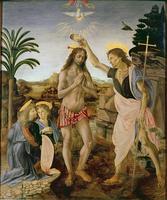
The Baptism of Christ
Leonardo da Vinci
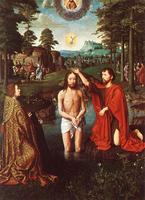
The Baptism of Christ (central section of Triptych of Jan des Trompes)
Gerard David
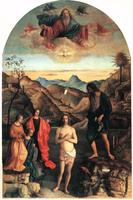
Baptism of Christ, St. John Altarpiece
Giovanni Bellini
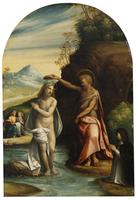
Baptism of Christ
Benvenuto Tisi
John the Baptist and four saints
Pietro Perugino
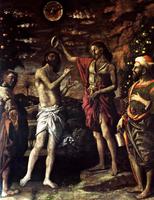
The Baptism of Christ
Andrea Mantegna
The Baptism of Christ
Cima da Conegliano
The Baptism of Christ
Joachim Patinir
Baptism of Jesus
Jan Joest
Baptism of Christ
Juan Carreno de Miranda
Baptism of Christ
Pietro Perugino
The Baptism of Christ
Giorgio Vasari
Baptism of Christ
Bartolome Esteban Murillo
Polyptych of St. Peter (Resurrection)
Pietro Perugino
Baptism of Christ
Mestre Ataíde