Expertenanalyse zu Bartolome Esteban Murillos The Rest on the Flight into Egypt
Stil: Baroque · Genre: religious painting
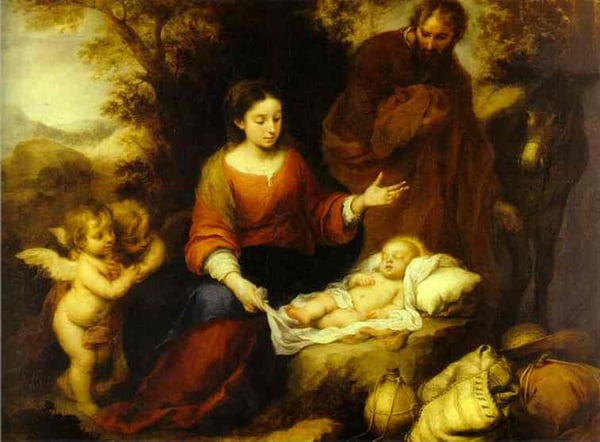
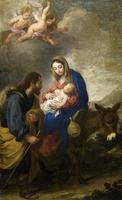
Bartolomé Esteban Murillo's The Rest on the Flight into Egypt stands as a quintessential example of Spanish Baroque religious painting, distinguished by its deliberate move away from dramatic intensity toward intimate, tender piety. While many Baroque artists of the seventeenth century emphasized theatrical chiaroscuro and dynamic movement, Murillo instead cultivated a soft, luminous palette and a serene, almost genre-like domesticity. This approach reflects the Counter-Reformation ideal of making sacred narratives accessible and emotionally resonant for the faithful.
In this work, Murillo depicts the Holy Family pausing during their escape into Egypt—an apocryphal subject that allowed artists to explore human vulnerability and divine grace simultaneously. The composition is notably calm: the Virgin Mary sits with the Christ Child, while Joseph rests nearby, often shown with a simple staff or accompanying donkey. Murillo’s hallmark is his treatment of light, which emanates gently from the infant Jesus, illuminating Mary’s face and creating a halo of warmth. This subtle glow, combined with soft, blended brushstrokes, imbues the scene with a sense of heavenly peace rather than earthly hardship.
What makes this painting significant within the Baroque period is Murillo’s unique synthesis of naturalism and idealism. Unlike the stark realism of contemporaries like Zurbarán or the dramatic intensity of Caravaggio, Murillo’s figures possess a sweet, idealized beauty that still feels grounded. The Virgin is not a remote queen but a young mother, tender and watchful. Joseph is a humble protector, often depicted as a thoughtful, elderly figure. This humanization of the Holy Family made Murillo enormously popular among the devout public and religious orders in Seville, where he worked primarily for churches and convents.
Furthermore, The Rest on the Flight into Egypt exemplifies Murillo’s role in shaping the Spanish Baroque devotional style. His works were prized for their ability to inspire prayer and contemplation without overwhelming the viewer. The painting’s significance lies in its balance of artistic refinement and spiritual accessibility—a hallmark of Murillo’s oeuvre that influenced later generations of Spanish and Latin American religious painters. In choosing quiet intimacy over spectacle, Murillo redefined how Baroque art could express the sacred, making this piece a key touchstone for understanding the softer, more empathetic strand of seventeenth-century religious painting.
Museum / Gallery
Visuell ähnlich
20 Werke mit ähnlicher Komposition und Farbpalette
The Holy Family
Jacopo Vignali
Adoration of the Magi
Jean II Restout
The Adoration of the Shepherds
Jan Cossiers
Mary and Child with Angels Playing Music
Bartolome Esteban Murillo
The Holy Family with the Infant Baptist
Bartolome Esteban Murillo
Nativity
Francesco Melzi
The sacred family
Ventura Salimbeni
The Holy Family with a Shepherd
Titian
Adoration of the Shepherds
Antonio González Velázquez
Nativity
Giovanni Battista Tiepolo
The Nativity with God the Father and the Holy Ghost
Giambattista Pittoni
Holy Family with the Infant Saint John
Bartolome Esteban Murillo
Adoration of the Shepherds
Bernardo Strozzi
The Holy Family with St. Anne and the Young St. John the Baptist
El Greco
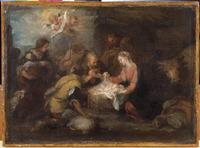
Adoration of the Shepherds
Bartolome Esteban Murillo
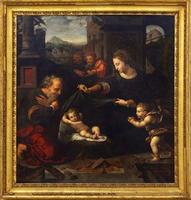
Nativity
Joos van Cleve
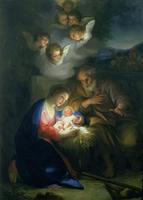
Nativity Scene
Anton Raphael Mengs
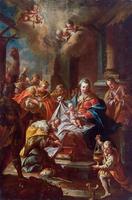
Adoration of the Child
Franz Anton Zeiller
Flight into Egypt
Bartolome Esteban Murillo
The Nativity with the Annunciation to the Shepherds Beyond
Bartolome Esteban Murillo