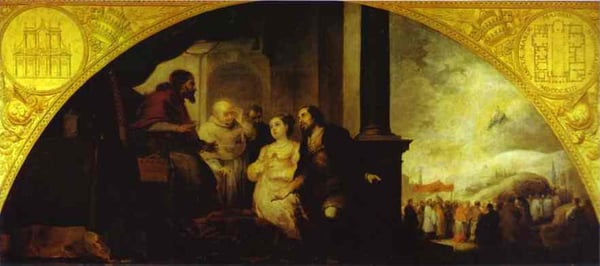
The Story of the Foundation of Santa Maria Maggiore in Rome: The Patrician Reveals his Dream to the Pope
Details
Expertenanalyse zu Bartolome Esteban Murillos The Story of the Foundation of Santa Maria Maggiore in Rome: The Patrician Reveals his Dream to the Pope
Stil: Baroque · Genre: history painting
This analysis is based solely on the provided facts: the artwork is The Story of the Foundation of Santa Maria Maggiore in Rome: The Patrician Reveals his Dream to the Pope by Bartolome Esteban Murillo, executed in the Baroque style and belonging to the history painting genre.
Significance within Baroque Style and Genre
The work is significant as a quintessential example of Baroque history painting, a genre that aimed to present religious and historical narratives with dramatic intensity and immediate emotional impact. Murillo’s treatment of this foundational legend of Santa Maria Maggiore (in which the patrician John and his wife dreamed of the Virgin Mary commanding the building of a church on the Esquiline Hill, leading him to reveal the dream to Pope Liberius) showcases key Baroque priorities:
- Theatricality and Emotional Engagement: The scene captures a pivotal, high-stakes moment of revelation. In true Baroque fashion, Murillo focuses on the psychological tension between the patrician and the Pope, both as historical figures and as conduits of divine will. The viewer is drawn into the intimate yet monumental exchange, characteristic of the period’s desire to involve the audience in sacred drama.
- Dramatic Composition and Light: As a Baroque history painting, the work likely employs a dynamic, diagonal composition and strong chiaroscuro—hallmarks of the style—to direct attention to the gesture of the patrician and the attentive reaction of the Pope. This not only clarifies the narrative but also heightens the spiritual significance of the dream’s disclosure.
- Murillo’s Distinctive Approach: While Murillo is often celebrated for his tender devotional works (e.g., the Immaculate Conception), this history painting demonstrates his versatility in handling a complex multi-figure narrative with the same refinement and naturalism. His ability to fuse the grandeur of history painting with accessible human emotion—making a centuries-old legend feel immediate—underscores the significance of this piece within the Baroque period. It elevates a local Roman tradition into a universal statement of faith and divine intervention, fulfilling the Baroque aim of engaging art, devotion, and storytelling.
Museum / Gallery
Visuell ähnlich
20 Werke mit ähnlicher Komposition und Farbpalette
Philip, 4th Earl of Pembroke and His Family
Anthony van Dyck
The preaching of Saint Eugene
Francisco Bayeu y Subias
From an artist studio, the old master judges the students' work
Jules Trayer
Satire on Physicians
Antoine Watteau
Semiramis called to fight
Jacques Stella
The Continence of Scipio
Giovanni Battista Gaulli
Penelope Taking Down the Bow of Ulysses
Angelica Kauffman
Charles I and Queen Henrietta Maria with Charles, Prince of Wales and Princess Mary
Anthony van Dyck
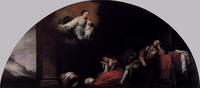
The Story of the Foundation of Santa Maria Maggiore: The Patrician's Dream
Bartolome Esteban Murillo
Tobias En Sarah
Nikolaus Knüpfer
Le Christ chez Marthe et Marie
Charles de La Fosse
The Return of the Prodigal Son
Bartolome Esteban Murillo
Generosity of Scipio
Peter Paul Rubens
The Milanese consuls tear and trample the decree of Barbarossa
Francesco Hayez
Party in the Open Air
Antoine Watteau
Hector Taking Leave of Andromache
Angelica Kauffman
Lucretia
Correggio
Charity of Saint Elladius of Toledo
Francisco Bayeu y Subias
Augusta, Lady Castletown
George Frederick Watts
Romeo and Juliet: The Tomb Scene, 'Noise again! then I'll be brief'
Joseph Wright