Camille Corot sanatçısının Civita Castellana eseri hakkında uzman analizi
Tarz: Realism · Tür: landscape
Expert Analysis: "Civita Castellana" by Camille Corot
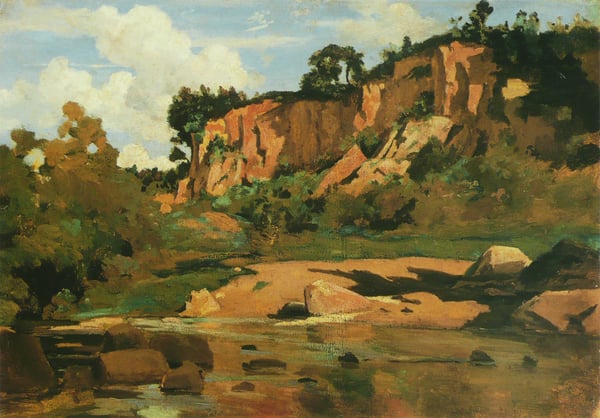
Camille Corot’s Civita Castellana stands as a pivotal work within the Realist landscape tradition, bridging the structured classicism of the early 19th century with the dawning atmospheric sensitivity of Impressionism. Painted during or shortly after Corot’s travels in Italy, the artwork captures the ancient hill town of Civita Castellana, about 50 kilometers north of Rome, with a remarkable blend of topographical accuracy and poetic tranquility.
Significance within Realism and Corot’s Oeuvre
-
Plein‑Air Naturalism: Corot was a pioneer of working directly from nature (en plein air), and Civita Castellana exemplifies his commitment to recording the specific qualities of a place—the rugged terrain, the soft Italian light, and the tactile textures of stone and vegetation. This direct observation aligns perfectly with Realism’s rejection of idealized, studio‑bound landscapes.
-
Tonal Harmony and Atmospheric Depth: Unlike many Realists who emphasized sharp detail, Corot infused the scene with a subtle, silvery tonality that mutes contrasts and creates a sense of enveloping atmosphere. The distant hills and sky melt into one another, foreshadowing the Impressionists’ fascination with light and air. This delicate handling of values gives the landscape a contemplative, almost dreamlike quality while remaining firmly grounded in observed reality.
-
Structural Composition: The composition is deceptively simple: a foreground of rocky terrain and scrub, a middle ground of ancient buildings clinging to the hillside, and a distant plain under a vast sky. Corot balances a classical sense of order—derived from his training under Neo‑classicists—with the irregular, organic forms of nature. The result is a landscape that feels both timeless and immediate.
-
Influence on Later Movements: Civita Castellana demonstrates why Corot is considered a crucial precursor to the Barbizon School and Impressionism. His ability to capture the transient effects of light and atmosphere while maintaining a solid, realist foundation made him a touchstone for artists like Daubigny, Pissarro, and even Monet.
In sum, this artwork is significant because it encapsulates Corot’s unique position as a Realist who looked both backward to classical landscape conventions and forward to the modern, subjective perception of nature. It elevates a humble Italian hillside into a study of light, structure, and quiet grandeur—proving that Realism need not be merely documentary but can be profoundly lyrical.
Görsel olarak benzer
İlişkili kompozisyon ve renk paletine sahip 20 eser
Two Italians, an Old Man and a Young Boy
Camille Corot
Flusslandschaft mit bewaldetem Ufer
Julius Lange
Bird-nesting
Philip Wilson Steer
Forest Lake
Ivan Shishkin
Beach
Ivan Shishkin
Forest Stream
Ivan Shishkin
Oak grove in a gray day
Ivan Shishkin
Landscape
Ivan Shishkin
Loup Scar, Wharfedale
Richard Jack
Wooded riverbank. Twilight.
Isaac Levitan
A river
Isaac Levitan
Cliff
Ivan Shishkin
Aqueduct
Camille Corot
Barranca del Muerto (Ravine of Death)
Jose Maria Velasco
On the Shore of the Gulf of Finland. Udrias Near Narva
Ivan Shishkin
After a storm in Mary-Howe
Ivan Shishkin
Landscape with brother's figure
Vasily Surikov
A Misty Morning
James Charles
Shinnecock Hills
William Merritt Chase
A Danish Coast. View from Kitnæs on Roskilde Fjord
Johan Lundbye