Analisi esperta di Cuicy Marsh, near Douai di Camille Corot
Stile: Realism · Genere: landscape
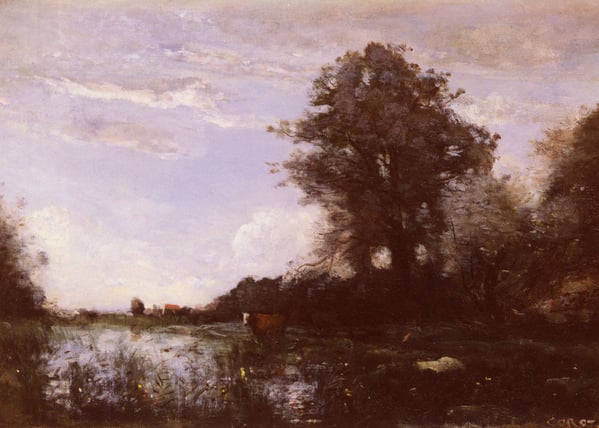
Camille Corot’s Cuicy Marsh, near Douai (c. 1871) is a serene landscape that exemplifies the transition from Neoclassical idealism to the direct observation of nature central to Realism. While Corot is often celebrated as a bridge to Impressionism, this work’s significance lies in its quiet, unembellished depiction of a specific, ordinary site—a marshland near the northern French town of Douai.
The painting embodies Realism’s commitment to portraying contemporary rural life without heroic or exotic sentiment. Corot’s muted palette of silvery greens, soft blues, and earthy browns captures the damp, hazy atmosphere of the marsh. Unlike the dramatic contrasts of Romantic landscape, the light is diffused and even, suggesting a specific time of day and weather condition observed directly from nature (a practice Corot championed through his plein-air studies). The composition is deliberately unassuming: a flat expanse of water and reeds, with a low horizon and a line of trees in the middle distance, punctuated by a small figure or two—possibly a peasant gathering reeds.
What makes this work significant within Realism is its refusal to idealize or moralize. Corot treats the marsh not as a picturesque motif but as a factual, almost topographical record of a place. The handling is both delicate and direct: brushwork varies from soft, almost feathery touches in the foliage to more fluid strokes in the water’s reflection, conveying the texture of wet earth and still air. This balance between rigorous observation and atmospheric subtlety prefigures the concerns of later Impressionists, yet Corot retains a classical sense of structure—the horizontal bands of marsh, bank, and sky anchor the scene.
Moreover, Cuicy Marsh reflects Corot’s lifelong fascination with the interplay of earth, water, and sky, and his ability to find poetry in the mundane. At a time when many Realist painters focused on social narratives (e.g., Millet’s peasants or Courbet’s laborers), Corot’s pure landscape asserts that nature itself—unadorned and quietly observed—is a worthy subject for serious art. This painting thus stands as a key example of how Realism expanded the boundaries of landscape painting, elevating the specific, the local, and the transient into art of enduring significance.
Museum / Gallery
Genere
Stile
Visivamente simili
20 opere con composizione e palette affini
Small Floodplain
Jules Dupre
Field by a River
Camille Corot
Pond with Dog
Camille Corot
Barbizon Landscape
Jules Dupre
Peasant Girl near a Cabin
Camille Corot
Near Arras, the Banks of the Scarpe
Camille Corot
On The Farm
Constant Troyon
A pond near Nangis
Paul Trouillebert
The Ponds of Ville d'Avray
Camille Corot
Study for The Leaping Horse (View on the Stour)
John Constable
Goatherd Standing, Playing the Flute under the Trees
Camille Corot
Evening Distant Tower
Camille Corot
Fisherman Boating along a Wooded Landscape
Camille Corot
Horseman in the Forest
Camille Pissarro
A june day
Charles-Francois Daubigny
Landscape
Theodore Rousseau
Landscape with a River
Aleksey Savrasov
East Loyal Field
Robert Julian Onderdonk
A Shady Resting Place
Camille Corot
Study at Orange County, New York
David Johnson