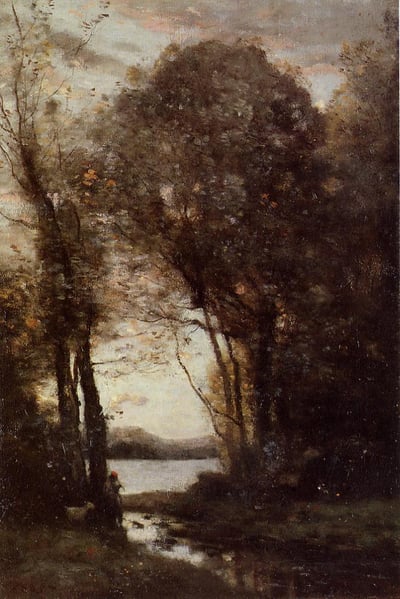
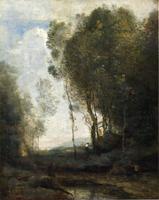
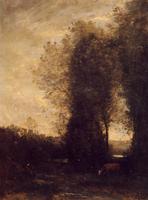
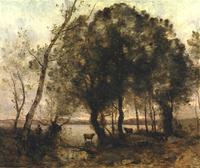
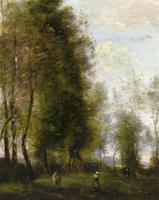
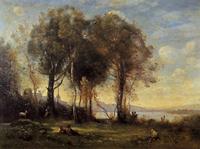
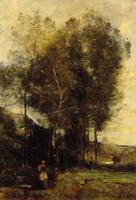
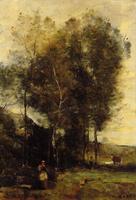
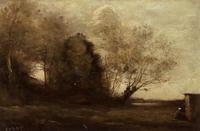
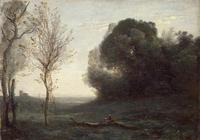
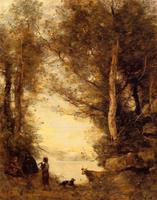
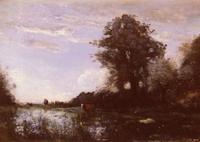
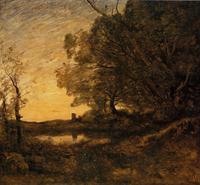
During the 19th century, Camille Corot bridged the classical landscape tradition and the emerging Realist movement. In Goatherd Standing, Playing the Flute under the Trees, Corot presents a pastoral idyll that is at once rooted in direct observation and infused with a serene, lyrical quality. The composition centers on a solitary goatherd—a figure from rural life—whose flute-playing becomes a gentle focal point beneath a canopy of trees. Corot’s handling of light and atmosphere, with soft, silvery greens and muted earth tones, exemplifies his signature “valeur”—a nuanced tonal harmony that would profoundly influence the Barbizon school and later Impressionists.
The painting’s significance lies in its fusion of Realist subject matter with a poetic sensibility. Rather than idealizing the landscape or the peasant, Corot elevates the everyday moment through a delicate play of filtered sunlight and subtle shadow, capturing the quiet dignity of rural existence. This work demonstrates how Corot expanded Realism beyond social documentation; he rendered nature not as a harsh fact but as a contemplative, harmonious environment. The flute-playing goatherd stands as a metaphor for the artist’s own role: a mediator between the natural world and the viewer, inviting us to pause and listen to the silent rhythm of the countryside.