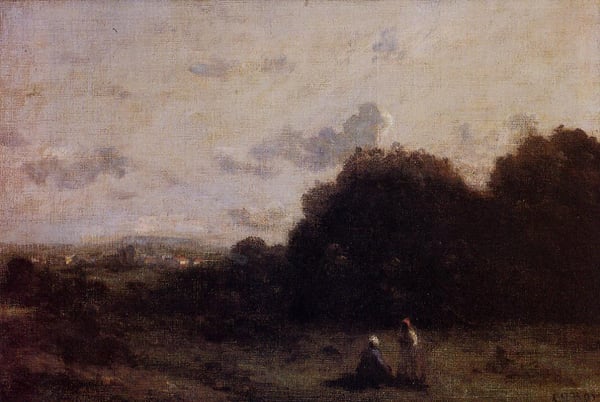
Fields with a Village on the Horizon, Two Figures in the Foreground
Expert analysis of Camille Corot’s Fields with a Village on the Horizon, Two Figures in the Foreground
Style: Realism · Genre: landscape
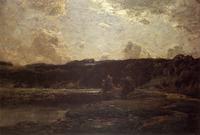
An expert analysis of Camille Corot's Fields with a Village on the Horizon, Two Figures in the Foreground reveals a work that quietly bridges the gap between the classical landscape tradition and the emerging Realist sensibility of the 19th century. While the piece is categorized under the style of Realism, Corot’s approach is uniquely poetic—anchored in direct observation yet softened by a lyrical, almost meditative light.
Significance within Realism and Corot’s Oeuvre:
Corot is a pivotal figure whose work helped define the Realist landscape, particularly as part of the Barbizon school. In this painting, the title itself points to a core Realist concern: the ordinary, everyday world. The scene is not a grand historical or mythological vista but a simple view of cultivated fields, a distant village, and two anonymous figures in the foreground. This choice democratizes landscape art, focusing on the quiet dignity of rural life without idealization.
What makes this work significant is Corot’s masterful treatment of atmosphere and light. The broad, open fields recede gently toward the horizon, creating a sense of depth and vastness that is both naturalistic and serene. The two small figures—likely peasants—are integrated into the landscape, underscoring a Realist tenet: humans are part of nature, not its masters. Their small scale against the expansive fields emphasizes the sublime, unassuming beauty of the everyday.
Corot’s technique here is also noteworthy. He uses a muted, silvery palette with subtle tonal transitions, a hallmark of his mature style. This is not the sharp, detailed observation of a photographer; rather, it is a selective realism that evokes the air, the light, and the quiet stillness of the countryside. The soft, hazy horizon line suggests an atmospheric perspective that would later influence the Impressionists—yet Corot remains firmly grounded in the structured, balanced composition of the Realist tradition.
In conclusion, Fields with a Village on the Horizon is significant because it demonstrates how Realism, in Corot’s hands, transcends mere documentation. It becomes a contemplative, harmonious vision of nature that honors the truth of the scene while elevating it through a gentle, personal lyricism. This balance—between observed reality and artistic feeling—marks Corot as a key transitional figure in 19th-century landscape painting.
Museum / Gallery
Visually similar
20 works with related composition and palette
Peasants near a Village
Camille Corot
Two Figures Working in the Fields
Camille Corot
Hamlet and the Gravedigger
Camille Corot
Landscape by the Lake
Camille Corot
Summer Twilight
Edward Mitchell Bannister

Landscape with Woman Walking on Path
Edward Mitchell Bannister
Outside Paris The Heights above Ville d'Avray
Camille Corot
Dark Trees, Cincinnati
John Henry Twachtman
Landscape
John Henry Twachtman
Clearing
Paul Gauguin
Lonesome Valley
Camille Corot
Common with Stormy Sunset
Narcisse-Virgilio Diaz
Landscape
Paul Trouillebert
View Towards The Rectory From East Bergholt House
John Constable
A Road through the Trees
Camille Corot
Peasant Girl near a Cabin
Camille Corot
Landscape
Edward Mitchell Bannister
The backwoods of St. Antony, Pontoise
Camille Pissarro
A Cow and its Keeper
Camille Corot
The River Bend
Julian Alden Weir