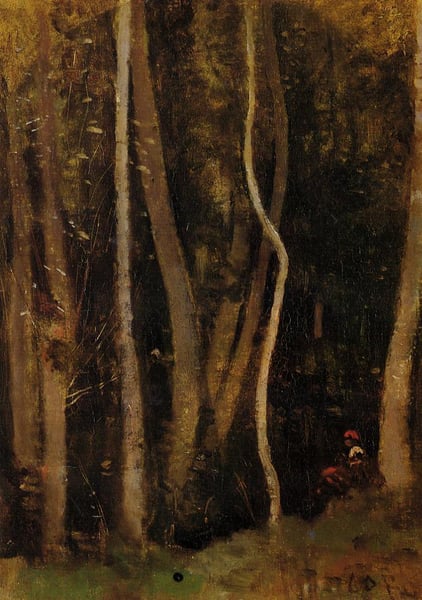
Expert analysis of Camille Corot’s Figures in a Forest
Style: Realism · Genre: landscape
Expert Analysis: Figures in a Forest by Camille Corot
Camille Corot’s Figures in a Forest stands as a hallmark of the Realist movement’s approach to landscape, demonstrating how the genre can transcend mere documentation to achieve a quiet, lyrical harmony between humanity and nature. Although the painting’s subject—a forest interior with small human figures—is drawn from everyday observation, Corot elevates it through a distinctive balance of atmospheric subtlety and structural clarity.
Significance within Realism and Landscape Tradition
Within the Realist style, Corot was a pivotal figure who bridged the classical landscape tradition with the emerging naturalism of the mid‑19th century. Unlike the heroic or idealized landscapes of earlier academic painting, Figures in a Forest captures an unassuming, non‑dramatic slice of rural life. The figures are not protagonists of a narrative; they are integrated into the environment, their small scale emphasizing the enveloping presence of the woods. This reflects Realism’s core tenet: to depict the ordinary world with truth and sincerity, free from literary or mythological embellishment.
Composition and Technique
Corot’s treatment of light and shadow is especially significant here. He employs a muted, silvery tonal palette—often described as “Corot’s veil”—that softens contours and unifies the scene. The dappled light filtering through the canopy creates a sense of depth and intimacy, while the loosely, yet deliberately, brushed foliage anticipates the impressionists’ interest in transient effects. Yet Corot never sacrifices structure: the vertical tree trunks anchor the composition, and the winding path leads the eye gently into the distance, a hallmark of his ability to balance naturalism with formal order.
Influence and Legacy
Figures in a Forest exemplifies why Corot is considered a precursor to Impressionism and a master of plein air painting. His method of working directly from nature, combined with a restrained, poetic sensitivity, influenced subsequent generations—from the Barbizon school to Monet and Pissarro. The work’s quiet monumentality and its fusion of human presence with untamed landscape cement its importance as a defining Realist statement, one that values the unadorned beauty of the natural world over rhetoric or idealization.
Museum / Gallery
Visually similar
20 works with related composition and palette
Thatched Cottage in Normandy
Berthe Morisot
A Birch Grove. Spots of sunlight
Arkhyp Kuindzhi
A Birch Grove
Arkhyp Kuindzhi
Forest road
Ivan Shishkin
Spring. Martyshkino
Konstantin Somov
Forest
Ivan Shishkin
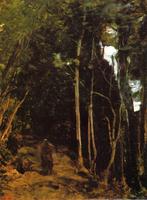
Forest in Fontainbleau
Camille Corot
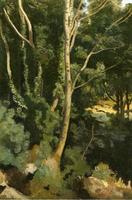
Landscape
Camille Corot
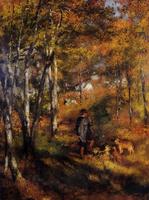
The Painter Jules Le Coeur Walking His Dogs in the Forest of Fontainebleau
Pierre-Auguste Renoir
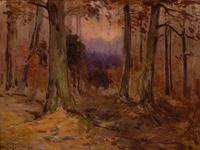
Landscape Sketch
Robert Julian Onderdonk
Forest stream
Ivan Shishkin
The Forest at Pontaubert
Georges Seurat
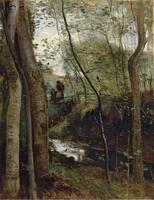
Stream in the Woods
Camille Corot
Covert
Ivan Shishkin
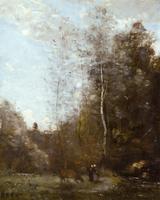
A Cow Grazing beneath a Birch Tree
Camille Corot
The path in the forest
Ivan Shishkin
Landscape with a Hunter. Valaam Island
Ivan Shishkin
Trees and Undergrowth
Vincent van Gogh
The last rays of the sun. Aspen forest.
Isaac Levitan
In the Forest
Ion Andreescu