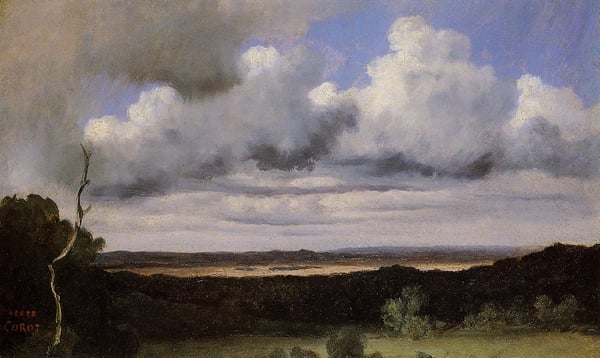
The significance of Camille Corot's “Rome, the Basilica of Constantine” lies in its pivotal position at the intersection of classical landscape tradition and emerging Realist observation. Though classified as a Realist landscape, the work demonstrates Corot’s unique ability to imbue a topographically accurate ruin with a luminous, almost poetic atmosphere—a hallmark that would later influence the Impressionists.
Painted during Corot’s early years in Italy, the composition adheres to the Realist mandate of direct observation from nature. Yet Corot does not merely document the ancient basilica; he subordinates its architectural mass to the gentle play of light and shadow, capturing the warm Roman air and the soft decay of the stone. This balance between structural fact and atmospheric feeling sets Corot apart from his Realist contemporaries, who often emphasized gritty social or topographical exactness. Instead, Corot filters reality through a nuanced, tonal sensitivity—a prelude to the plein-air immediacy of the Barbizon school and later Impressionism. The painting is thus significant as a bridge: it retains the compositional stability of Neoclassicism while embracing the empirical gaze of Realism, establishing Corot as a foundational figure in the evolution of modern landscape painting.