Expert analysis of Camille Corot’s The Roman Cammagna, with the Tiber
Style: Realism · Genre: landscape
Expert Analysis of "The Roman Cammagna, with the Tiber" by Camille Corot
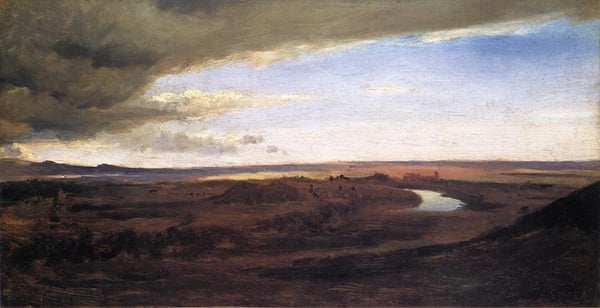
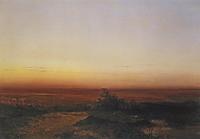
Camille Corot’s The Roman Cammagna, with the Tiber stands as a pivotal work within the Realist movement, demonstrating the artist’s unique ability to synthesize classical compositional order with a newly direct, observational fidelity to nature. The painting depicts the Roman Campagna—the rolling, historic countryside surrounding Rome—with the Tiber River winding through the landscape. As a Realist landscape, it rejects the idealized, dramatic scenery favored by earlier Romantic painters in favor of a quieter, more truthful depiction of light, atmosphere, and terrain.
Significance in Realism and Corot’s Oeuvre
Corot is often regarded as a bridge between the Neoclassical tradition of structured landscape painting and the emerging Realist and Impressionist sensibilities. In this work, his significance lies in three key areas:
-
Atmospheric Truthfulness: Corot captures the specific, silvery quality of Italian light—soft, diffused, and subtly enveloping. The Tiber is not a heroic river but a calm, reflective presence, its surface painted with delicate tonal gradations that avoid sharp contrasts. This attention to the actual conditions of outdoor light early on prefigures the plein air practices that later defined the Barbizon School and Impressionism.
-
Subtle Compositional Balance: While Realist, Corot retains a classical sense of structure. The distant hills, the river’s curve, and the foreground vegetation are arranged in a calm, horizontal recession—a nod to Claude Lorrain. Yet the handling is looser and more naturalistic; trees are not perfectly shaped but show the irregularities of growth. This blend of order and spontaneity makes the painting a mature example of Corot’s “poetic Realism,” where truth to nature is filtered through a refined, lyrical sensibility.
-
Influence on Modern Landscape: The Roman Cammagna, with the Tiber exemplifies Corot’s role as a precursor to plein-air Realism. His practice of making on-site sketches (études) and then composing studio works based on them allowed him to achieve both freshness and permanence. Artists from the Barbizon School (like Daubigny and Rousseau) and later Impressionists (Monet, Pissarro) cited Corot’s ability to capture transient atmospheric effects as foundational.
Conclusion
In this painting, Corot achieves what great Realist landscapes strive for: the convincing simulation of a specific place at a specific time, elevated by a serene, almost melancholic poetry. The work is significant not only for its technical mastery of light and space but also as a document of the shift from idealized nature to observed nature—a cornerstone of Realist art that would resonate through the rest of the 19th century.
Museum / Gallery
Visually similar
20 works with related composition and palette
On the Volga
Aleksey Savrasov
Rome, the Basilica of Constantine
Camille Corot
Volga
Aleksey Savrasov
Volga Lagoon
Fyodor Vasilyev
View of mountains, Auvergne
Theodore Rousseau
Gathering Clouds
Benjamin Brown
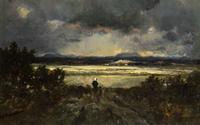
Sunset in the Auvergne
Theodore Rousseau
Steppe in the evening
Arkhyp Kuindzhi
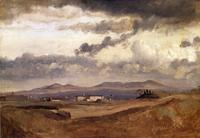
A Windmill at Montmartre
Camille Corot
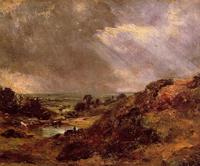
Branch Hill Pond Hampstead
John Constable
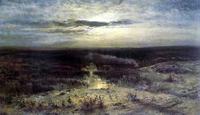
Moonlit night. Marsh
Aleksey Savrasov
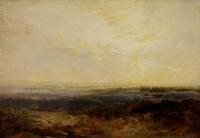
The Sussex Weald
James Webb
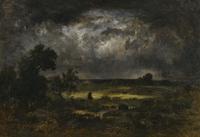
The Storm
Narcisse-Virgilio Diaz
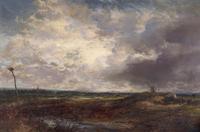
A Bit of Sussex
James Webb
Wooded Plateau, Fountainebleau
Camille Corot
Sunset Landscape
Thomas Stuart Smith
Cloud over the mountain valley
Arkhyp Kuindzhi

Golden Evening, Southwest Texas
Robert Julian Onderdonk
Volga
Aleksey Savrasov
Dawn in the desert
Aleksey Savrasov