Expertenanalyse zu Camille Corots In the Vicinity of Geneva
Stil: Realism · Genre: landscape
Expert Analysis: "In the Vicinity of Geneva" by Camille Corot
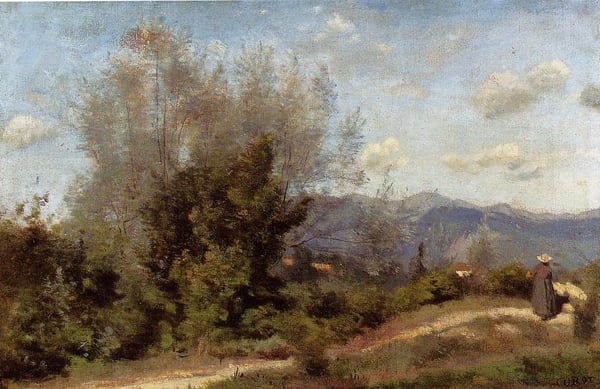
Camille Corot’s In the Vicinity of Geneva stands as a pivotal work within the Realist landscape tradition, bridging the structured classicism of the early 19th century with the atmospheric, light-infused experiments that would later define Impressionism. While Corot is often celebrated for his “paysage intime” (intimate landscapes), this painting exemplifies his mastery of balanced composition and tonal harmony, two hallmarks that made his approach to Realism profoundly influential.
Significance Within the Realist Period
Realism, as a movement, sought to depict the world without idealization—grounding art in the observable truths of everyday life and nature. Corot, however, brought a lyrical sensitivity to this mission. In In the Vicinity of Geneva, he does not simply record the Swiss landscape with documentary fidelity; rather, he captures the transient, soft light of the region, using a muted palette of silvery greens and warm earth tones. This delicate handling of atmosphere elevates the scene beyond mere topographical accuracy, offering a contemplative, almost poetic realism. Corot’s approach was significant because it validated the idea that a landscape could be both faithful to nature and deeply personal—a key step away from the formulaic, heroic landscapes of Neoclassicism.
Technical and Stylistic Contributions
Corot’s brushwork here is both precise and breathable. He constructs the scene with a clear foreground, middle ground, and distant mountains, yet the edges are softened, and the light seems to filter through a veil of moisture—a common feature in his Swiss views. This technique of sfumato-like blurring, coupled with his restrained value range, creates a sense of depth and stillness that feels remarkably modern. The composition is carefully balanced: a cluster of trees on the left anchors the view, while a path or waterway draws the eye into the serene expanse, inviting the viewer to linger.
Impact on Later Art
Corot’s significance lies in his role as a precursor. Artists of the Barbizon school (such as Rousseau and Millet), and later the Impressionists (especially Monet and Sisley), directly inherited Corot’s interest in plein air painting, his refined treatment of light, and his belief that a landscape’s emotional resonance was as important as its literal details. In the Vicinity of Geneva encapsulates this transitional moment: it is firmly rooted in Realism’s dedication to the natural world, yet it presages the looser, more color-driven explorations of the late 19th century. For these reasons, the work is not merely a charming view—it is a cornerstone in the evolution of modern landscape painting.
Museum / Gallery
Visuell ähnlich
20 Werke mit ähnlicher Komposition und Farbpalette
View of Chalet de Chenes, Bellvue, Geneva
Camille Corot
Pontoise Landscape, Through the Fields
Camille Pissarro
Near Antibes
Eugene Boudin
The Severes Hills Le Chemin Troyon
Camille Corot
In the Woods
Camille Pissarro
Landscape with Woman Walking on Path
Edward Mitchell Bannister
Peasants near a Village
Camille Corot
Two Figures Working in the Fields
Camille Corot
Landscape at Cagnes
Pierre-Auguste Renoir
Rural Guardsman in the Fountainbleau Forest
Alfred Sisley
Campaign with a female figure
Silvestro Lega
Young Woman Standing near a Farmhouse in Milly
Pierre-Auguste Renoir
Washerwomen on the Riverbank
Charles-Francois Daubigny
Resting in the woods Pontoise
Camille Pissarro
Approaching the storm
Léon Augustin Lhermitte
A Road in Louveciennes
Pierre-Auguste Renoir
Hamlet and the Gravedigger
Camille Corot
On vacation
Silvestro Lega
Sevres Brimborion View toward Paris
Camille Corot
Landscape
Paul Trouillebert