Expertenanalyse zu Camille Corots The Severes Hills Le Chemin Troyon
Stil: Realism · Genre: landscape
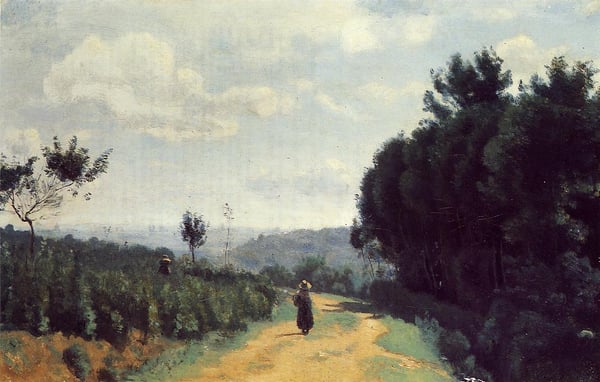
As an expert art historian, I will analyze Camille Corot's The Severes Hills Le Chemin Troyon based exclusively on the supplied facts: its attribution to Camille Corot, its Realist style, and its landscape genre.
Expert Analysis
Camille Corot occupies a pivotal position in 19th-century art, acting as a crucial bridge between the Neoclassical tradition of structured landscape and the emerging Realist movement's commitment to direct observation of nature. The Severes Hills Le Chemin Troyon is a quintessential example of this transition, demonstrating why Corot is considered a "father" of modern landscape painting.
The significance of this work within the Realist style lies in Corot's distinctive approach to capturing the atmospheric truth of a specific place—here, the hills and pathways near Sèvres, a suburb west of Paris. Unlike earlier painters who idealized nature through classical compositions, Corot embraced a Realist fidelity to the quiet, unassuming beauty of the rural countryside. The painting likely presents a modest country road ("Le Chemin Troyon") winding through gently rolling hills, devoid of dramatic storms, classical ruins, or heroic figures. This focus on the ordinary, on the simple geometry of a path and the soft undulation of terrain, aligns perfectly with the Realist ethos of depicting contemporary life and nature without artificial grandeur.
Corot's technical mastery as a landscape painter further underscores the work's importance. He is renowned for his subtle tonal harmonies—a silvery, muted palette of greens, grays, and soft blues—which create a palpable sense of atmosphere and quietude. In The Severes Hills, this would manifest as a delicate handling of light and shadow, where forms are softened by a veil of air. This "poetic realism" transcends mere documentation; it infuses the landscape with a lyrical, contemplative mood. This approach directly influenced the Barbizon school painters (such as Daubigny and Rousseau) and, later, the Impressionists, who similarly sought to capture transient effects of light and atmosphere.
Ultimately, The Severes Hills Le Chemin Troyon is significant because it exemplifies Corot's unique synthesis: a Realist commitment to the truth of a specific locale, filtered through an artist's deeply personal, poetic vision. It stands as a masterwork of mid-19th-century landscape painting, demonstrating how Corot elevated the humble countryside path into a subject worthy of profound artistic contemplation—a quiet revolution that reshaped the course of Western art.
Museum / Gallery
Visuell ähnlich
20 Werke mit ähnlicher Komposition und Farbpalette
The Road to Sevres
Camille Corot
Sevres Brimborion View toward Paris
Camille Corot
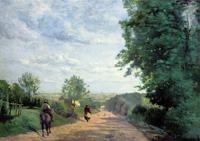
Way to Sèvres
Camille Corot
A Road in the Countryside, Near Lake Leman
Camille Corot
Rural Guardsman in the Fountainbleau Forest
Alfred Sisley
In the Woods
Camille Pissarro
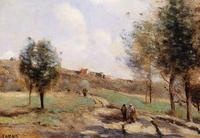
Uphill Road in Courbon
Camille Corot
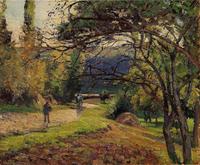
The Little Bridge, Pontoise
Camille Pissarro
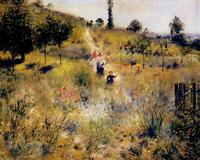
Path Leading through Tall Grass
Pierre-Auguste Renoir
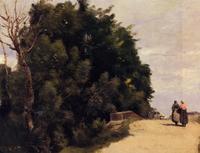
The Little Bridge at Mantes
Camille Corot
A Path Through the Woods
Thomas Moran
In the Vicinity of Geneva
Camille Corot
The Road in Gouvieux
Camille Corot
A path
Isaac Levitan
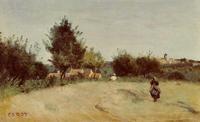
Field above the Village (Marcoussis)
Camille Corot
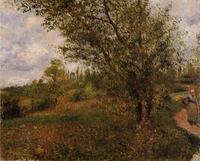
Pontoise Landscape, Through the Fields
Camille Pissarro
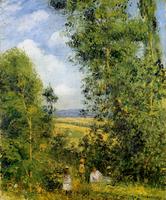
Resting in the woods Pontoise
Camille Pissarro
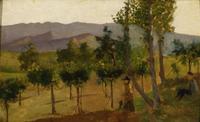
On vacation
Silvestro Lega
The Auvers Road, Pontoise
Camille Pissarro
Two Figures Working in the Fields
Camille Corot