Expert analysis of Camille Corot’s A Seated Italian from Paeigno Facing Front
Style: Realism · Genre: landscape
Expert Analysis: "A Seated Italian from Paeigno Facing Front" by Camille Corot
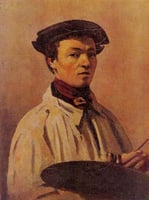
Camille Corot’s A Seated Italian from Paeigno Facing Front exemplifies the nuanced intersection of Realism with the landscape tradition, even when depicting a figure. Although the work’s genre is listed as landscape, Corot’s approach here is deeply rooted in the Realist commitment to direct observation and truth to nature—principles he applied equally to people and places. The figure is not isolated in a studio but presented as part of a broader environmental context, likely studied en plein air during his travels in Italy.
Significance within Realism and Corot’s Oeuvre:
-
Integration of Figure and Setting: Despite the title’s emphasis on the seated man, Corot treats the sitter as a natural component of the landscape, avoiding the idealized, heroic poses of academic history painting. The figure’s relaxed, frontal posture and unvarnished gaze align with Realism’s rejection of artifice.
-
Transitional Role: Corot stands as a pivotal link between the classical landscape tradition of the 17th century and the emerging Realist (and later Impressionist) sensibility. In this work, his subtle modulation of light and shadow on the Italian subject’s face and clothing prefigures the plein-air immediacy that would define later movements.
-
Ethnographic Authenticity: The specificity of “Paeigno” (likely a misspelling of a local Italian village) underscores Realism’s interest in everyday people and regional character. Corot does not romanticize the sitter but records his simple, unassuming presence—a hallmark of the Realist drive to portray contemporary life without embellishment.
-
Landscape as Unifier: By classifying the work under landscape, the structured facts hint that the setting—perhaps a rustic hillside or a courtyard—is not mere background but an equal participant in the composition. The figure’s earth-toned clothes and grounded posture harmonize with the natural environment, reinforcing the Realist belief that humanity is inseparable from its habitat.
Conclusion: This Corot painting is significant for demonstrating how Realism extended beyond pure landscapes to incorporate the human figure as a vital, unidealized element of the observed world, anticipating the plein-air revolution of the later 19th century. Its quiet dignity and factual rendering make it a benchmark of Corot’s mature, naturalistic style.
Museum / Gallery
Visually similar
20 works with related composition and palette
Landscape
Alfred Parsons
Valley of the Gipping, Suffolk
Frederick George Cotman
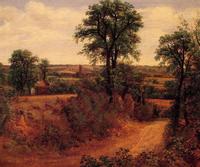
A Lane near Dedham
John Constable
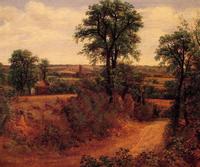
Fen Bridge Lane
Thomas Gainsborough
The valley of Bièvre near Paris
Theodore Rousseau
Path Towards a House in the Countryside
Camille Corot
Australian Pastoral
Louis Buvelot
Peasants
Martín Rico y Ortega
A Path Through the Woods
Thomas Moran
Landscape
Volodymyr Orlovsky
Sevres Brimborion View toward Paris
Camille Corot
Lengthening Shadows
Julian Alden Weir
The Saint Antoine Road at l'Hermitage, Pontoise
Camille Pissarro
A road
Ivan Shishkin
Landscape
Maurice de Vlaminck
Summer day. Trees
Ivan Shishkin
A Road through the Trees
Camille Corot
Green Slope on the Road. Martyshkino
Konstantin Somov
Saint Andre en Morvan
Camille Corot
Ville d'Avray the Pond and the Cabassud House
Camille Corot