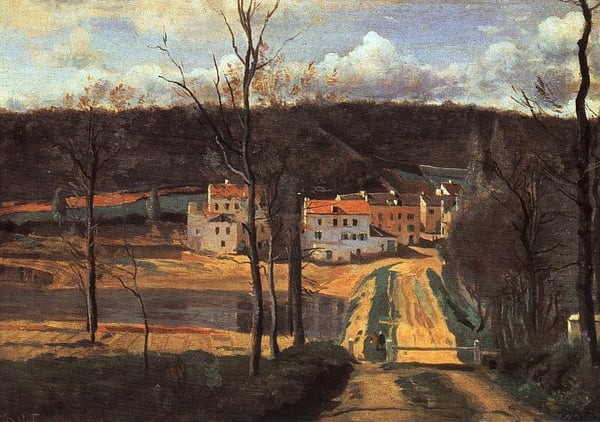
Analisi esperta di Ville d'Avray the Pond and the Cabassud House di Camille Corot
Stile: Realism · Genere: landscape
Expert Analysis: "Ville d'Avray the Pond and the Cabassud House" by Camille Corot
As a landmark of Realist landscape painting, Corot’s "Ville d’Avray the Pond and the Cabassud House" embodies the movement’s core ambition: to render the natural world with unidealized truth while preserving a lyrical, atmospheric harmony. Painted in the artist’s beloved home village, the work stands at the cusp of Corot’s mature period, where he synthesized direct observation from nature (a key Realist practice) with a soft, silvery palette that would later influence the Impressionists.
Significance within Realism and Landscape Tradition:
-
Realist Fidelity to a Specific Locale: Unlike the grand, classical landscapes of the earlier 19th century, Corot focuses on a humble, domestic view—the pond and the Cabassud house—treating an everyday rural subject with the same seriousness as a history painting. This aligns with Realism’s rejection of idealized Arcadia in favor of the actual, lived environment of Ville d’Avray.
-
Atmospheric Naturalism: Corot’s handling of light and atmosphere is a hallmark. The muted, pearly tones and soft reflections on the pond demonstrate his obsession with capturing the transient effects of weather and time of day—a direct response to observing nature en plein air. This emphasis on natural light, rather than artificial studio composition, marks a crucial step toward the later Realist and Impressionist commitment to perceptual truth.
-
Poetic Realism: While firmly rooted in the real, the painting avoids harsh social commentary (as seen in Courbet’s works). Instead, Corot’s Realism is contemplative and lyrical: the balanced composition, delicate foliage, and still water create a sense of quiet permanence. This synthesis of objective observation and subjective mood—what critics called “Corot’s silvery veil”—made him a bridge figure between Romanticism, Realism, and the nascent Impressionist movement.
-
Influence on Modern Landscape Painting: Corot’s refusal to dramatize or moralize nature, combined with his subtle tonal modeling and broken brushwork, directly paved the way for artists like Monet and Pissarro. Ville d’Avray the Pond and the Cabassud House is thus significant not only as a masterful Realist document of a specific place but as a precursor to the even more radical light-and-color studies that would define Parisian avant-garde painting in the decades to come.
Visivamente simili
20 opere con composizione e palette affini
Ville d'Avray the Chemin de Corot
Camille Corot
The Saint Antoine Road at l'Hermitage, Pontoise
Camille Pissarro
Road at Pontoise
Paul Cezanne
Pontoise, Les Mathurins
Camille Pissarro
Louveciennes
Camille Pissarro
A Village through the Trees
Camille Pissarro
Banks of the river Marne in winter
Camille Pissarro
Cowherd and Her Child
Camille Corot
Louveciennes
Camille Pissarro
Village at the Foot of a Hill, Ile de France
Camille Corot
A Seated Italian from Paeigno Facing Front
Camille Corot
The Rising Path, Pontoise
Camille Pissarro
Path of Hermitage at Pontoise
Camille Pissarro
Landscape With A White Horse In A Field, L'Ermitage
Camille Pissarro
Landscape with a White Horse in a Meadow, L'Hermitage
Camille Pissarro
Landscape at Osny near watering
Camille Pissarro
The Mill at La Roche Goyon
Camille Pissarro
Ville d'Avray, the Large Pond and Villas
Camille Corot
The Banks of the Seine at Bougival
Camille Pissarro
Entrance to the Village of Voisins, Yvelines
Camille Pissarro