Analisi esperta di Morning, the Dance of the Nymphs di Camille Corot
Stile: Realism · Genere: mythological painting
Expert Art Historical Analysis: "Morning, the Dance of the Nymphs" by Camille Corot
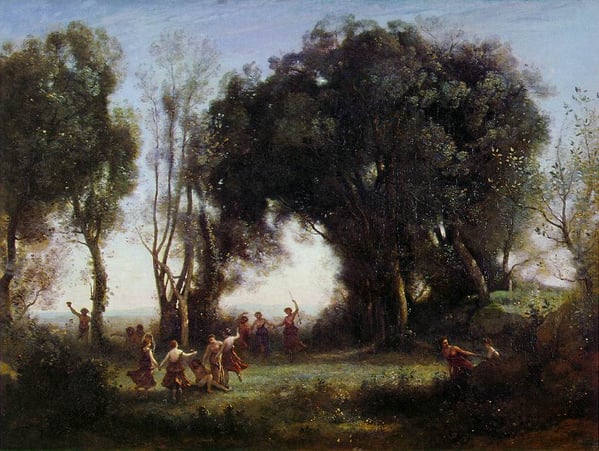
Camille Corot’s "Morning, the Dance of the Nymphs" occupies a pivotal position in 19th-century French painting, where the conventions of mythological imagery are infused with the observational truth of Realism. Though the subject is drawn from classical myth—nymphs dancing in a sylvan glade—Corot transforms the scene into a study of natural light, atmosphere, and the quiet poetry of the everyday landscape. This work is significant for how it bridges two seemingly opposed modes: the idealized, literary tradition of mythological painting and the emerging Realist commitment to depicting nature as it appears.
Mythology Reimagined Through Realist Eyes
Unlike the grandiose, theatrical nymphs of Neoclassical masters (such as Bouguereau or Poussin), Corot’s figures are ethereal, almost transparent, and integrated seamlessly into their environment. They do not dominate the composition; rather, they become part of the landscape’s rhythm—a shimmer of white and pink among the soft greens and silvery grays. This demotion of the human figure to an element of the natural world is a hallmark of Corot’s mature style and a key step toward the plein-air naturalism that would later define the Barbizon school and Impressionism.
Atmospheric Realism and the "Corot Effect"
What sets this painting apart is Corot’s mastery of sfumato and his unique handling of morning light. The misty, hazy quality of the dawn air envelops the scene, blurring the boundary between trees, sky, and dancing forms. This “Corot effect”—a soft, pearly luminosity achieved with subtle tonal gradations—was lauded by critics as a new kind of realism: not a photographic copy of nature, but an impression of its transient mood. By applying Realist principles (direct observation of light and atmosphere) to a mythological theme, Corot demonstrates that even an imaginary, arcadian world can feel true to the sensory experience of a real morning.
Significance as a Transitional Work
"Morning, the Dance of the Nymphs" is significant as a bridge between Romanticism’s poetic ideal and Realism’s empirical observation. Corot’s contemporaries, including Delacroix, admired his ability to elevate a humble woodland scene to something timeless and serene. Later, the Impressionists (Monet, Renoir) would credit Corot’s atmospheric landscapes as a direct influence on their own studies of light and reflection. In this painting, the nymphs are not just mythological creatures—they are the spirit of nature itself, made palpable through the artist’s Realist eye.
Visivamente simili
20 opere con composizione e palette affini

Morning: Dance of the Nymphs
Camille Corot

Orpheus Lamenting Eurydice
Camille Corot

Circle of Nymphs, Morning
Camille Corot

Outskirts of a Wood, with Gypsies
David Cox

Pastorale
Camille Corot

View near Naples
Camille Corot

Roman Ideal Landscape with Cephalus, Procris, and Diana
Claude Lorrain
Orpheus Leading Eurydice from the Underworld
Camille Corot

Recollections of Mortefontaine
Camille Corot

The Skylark
David Cox
Orpheus Leading Eurydice from the Underworld
Camille Corot

Souvenir of Mortefontaine
Camille Corot

The Bath of Diana
Camille Corot

Bathers of the Borromean Isles
Camille Corot

Animated landscape
Gabriele Smargiassi

Morning
Camille Corot

Forest scene
Jacob van Ruisdael

Landscape with Erminia in Discourse with the Old Man and his Sons
Claude Lorrain

Hunter in landscape
Andreas Achenbach

The Goatherds of Castel Gandolfo
Camille Corot