Camille Corot sanatçısının Mountains in Auvergne eseri hakkında uzman analizi
Tarz: Realism · Tür: landscape
Expert Analysis of Camille Corot’s Mountains in Auvergne
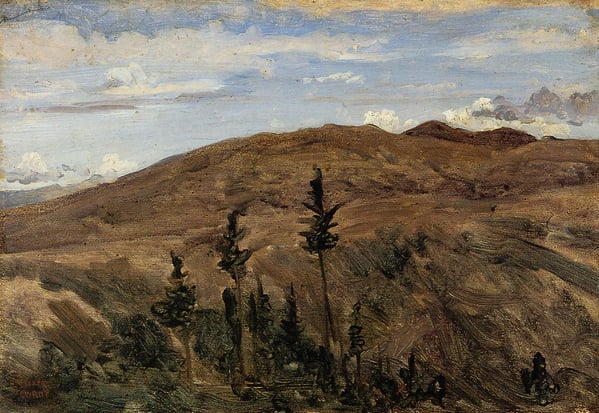
Camille Corot’s Mountains in Auvergne stands as a quintessential example of Realist landscape painting, a movement that sought to depict nature with unidealized truthfulness. Created during a period when Romanticism and Classicism still held sway, Corot’s work aligns with Realism’s core tenets: direct observation of the natural world, rejection of theatricality, and fidelity to the artist’s firsthand experience.
Significance within Realism
Corot’s treatment of the Auvergne region—a rugged, volcanic landscape in central France—emphasizes the specific topography and atmospheric conditions rather than imposing a grand narrative or classical composition. The painting’s subdued palette, nuanced handling of light, and careful attention to the geological structure of the mountains reflect Realism’s commitment to capturing the ordinary yet profound beauty of the natural environment. Unlike earlier landscape traditions that idealized pastoral scenes, Corot presents the terrain with a quiet, almost documentary clarity, inviting viewers to appreciate its unembellished reality.
Corot’s Role in the Movement
While often associated with the Barbizon school, Corot developed a distinctive approach that bridged Neoclassicism and Realism. In Mountains in Auvergne, this synthesis is evident: the balanced, structured composition recalls classical landscape conventions, but the earthy tones, soft transitions of light, and emphasis on local geology belong squarely to Realist observation. The work thus exemplifies how Corot helped redefine landscape painting by grounding it in empirical study—a key contribution to the Realist ethos.
Why It Matters
This piece is significant for its demonstration of Realism’s ability to find majesty in the unromanticized countryside. Corot’s sensitive rendering of the Auvergne mountains—neither exaggerated nor sentimental—paved the way for later Realists and Impressionists who would further explore the interplay of light, atmosphere, and the specific character of a place.
Museum / Gallery
Görsel olarak benzer
İlişkili kompozisyon ve renk paletine sahip 20 eser
Village Makravank
Martiros Sarian
Woods
Harry Phelan Gibb
Landscape
Paul Cezanne
Landscape
Marià Fortuny
Landscape of Athens
Nikolaos Lytras
Head of Bearded Man (Study for The Baptism of Christ )
Camille Corot
Sand pit
Paula Modersohn-Becker
Mount Soracte
Camille Corot
The Yellow Tree, La Granja
Joaquín Sorolla
Wild grass
Arkhyp Kuindzhi
Landscape of San Marcello Pistoiese
Odoardo Borrani
Below Mount Monadnock
Abbott Handerson Thayer
Landscape with Animals
Salvador Dali
Mountainous riverbank of Oyat
Vasily Polenov
Tyrolean Landscape. Study for Der Sämann
Albin Egger-Lienz
Branchville
John Henry Twachtman
Green Landscape
Auguste Herbin
Paradise Rocks, Newport
John Henry Twachtman
A ventania
Anita Malfatti
Valley in Pontgibaud
Armand Guillaumin