Expertenanalyse zu Auguste Herbins Green Landscape
Stil: Impressionism · Genre: landscape
Expert Art Historical Analysis: Green Landscape by Auguste Herbin
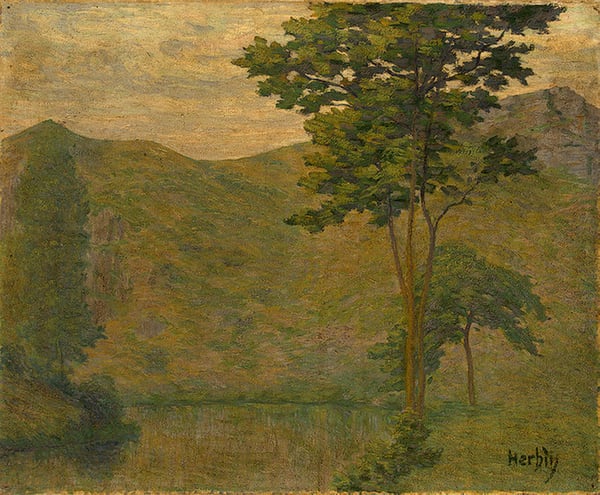
While Auguste Herbin is best known for his later geometrically abstract and Cubist works, Green Landscape stands as a significant example of his early engagement with the Impressionist movement. Painted in the style of Impressionism and belonging to the landscape genre, the work captures the movement’s core preoccupations: the transient effects of light, the primacy of color, and the sensory experience of nature.
Significance within Impressionism
The title itself, Green Landscape, foregrounds a chromatic choice that is both bold and emblematic of Impressionist practice. Herbin’s use of green is not merely descriptive but exploratory—likely employing a range of green hues—from emerald and olive to pale chartreuse—to model form and atmosphere. This palette-obsessed approach reflects the Impressionist rejection of local color in favor of perceived color, where the artist paints what the eye sees at a given moment under specific light conditions. The absence of strong black outlines and the probable presence of broken, dappled brushstrokes would create a vibrating, optical effect that dissolves solid forms into shimmering patches of light and shadow, a hallmark of the style.
Genre and Composition
As a landscape, the work aligns with the Impressionists’ preferred motif of the plein air scene—perhaps a meadow, a riverbank, or a garden. The painting’s significance lies in its apparent focus on an unpicturesque, everyday view, elevating a simple green vista to the status of a serious artwork. This democratic choice of subject matter, devoid of historical or mythological narrative, allows the painting to become a pure study of atmospheric conditions. The color green, often associated with tranquility and renewal, would here be treated not as a static field but as a dynamic, living substance shaped by sunlight.
Herbin’s Place in Art History
What makes Green Landscape particularly noteworthy is its position as a transitional work. Even within the bounds of Impressionism, Herbin’s future departure toward Fauvism and Cubism can be sensed in an assertive color sense or a nascent structural clarity. The painting illustrates that Impressionism, far from being a monolithic style, was a fertile ground for artists who would later innovate radically. The concentrated use of a single color family—the titular green—hints at a modernist interest in formal reduction that Herbin would fully realize in his abstract period.
In summary, Green Landscape is significant as a pure Impressionist landscape that demonstrates the movement’s radical redefinition of painting: the subject is light, the method is color, and the effect is a fleeting, sensory immersion in nature. It also offers a rare glimpse of an artist on the cusp of abandoning that very style for the avant-garde.
Visuell ähnlich
20 Werke mit ähnlicher Komposition und Farbpalette
Vid Skogsbrynet
Eugène Jansson
On the Hillside
Leon Dabo
Landscape
Ralph Blakelock
Mountain Lake with Figures
William Hart
Clearing in the Bois Pierre, at Eveaux near Chateau Thiery
Camille Corot
Landscape with figure
Joan Brull
Smugglers
Camille Corot
The Edge of the Forest
Camille Corot
Landscape
Joan Brull
Roman Countryside Rocky Valley with a Herd of Pigs
Camille Corot
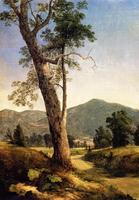
Landscape Beyond the Tree
Asher Brown Durand
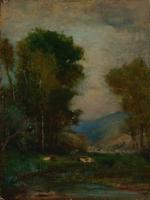
Cows by a Stream
George Inness
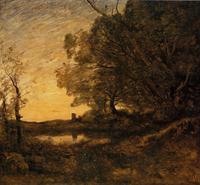
Evening Distant Tower
Camille Corot
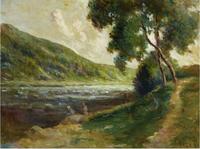
The Banks Of The Seine In The Surroundings Of Rolleboise
Maximilien Luce
Two Roe Deers in the Forest
Gustave Courbet
Early Moonrise, Florida
George Inness
Tulip Tree, Greenwich
John Henry Twachtman
Coucher De Soleil
Ferdinand du Puigaudeau
Landscape With Figures
Joan Brull
Der blaue Berg
Lesser Ury