Expert analysis of Camille Corot’s Olevano, the Town and the Rocks
Style: Realism · Genre: landscape
Expert Art Historical Analysis: "Olevano, the Town and the Rocks" by Camille Corot
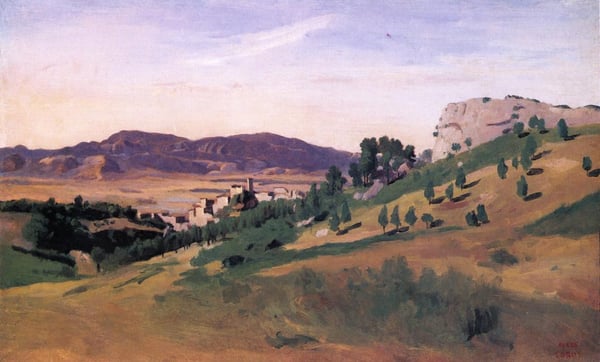
Camille Corot’s "Olevano, the Town and the Rocks" stands as a pivotal work within the Realist tradition, exemplifying the movement’s commitment to direct, unidealized observation of nature. Painted during Corot’s formative Italian sojourn, the landscape genre here is elevated by a rigorous balance between topographical accuracy and atmospheric sensitivity—a hallmark of Corot’s mature style.
Significance within Realism:
Unlike the theatricality of Romanticism, Corot’s Realism anchors itself in the specific, tangible details of the Italian hill town of Olevano. The rocks are rendered with geological fidelity, their rugged textures and warm ochres anchored in the local limestone, while the town’s clustered architecture emerges organically from the terrain. This insistence on plein air observation—Corot often sketched directly from nature—rejects ideal classical landscapes in favor of a faithful record of place and light.
Compositional and Technical Innovation:
Despite its Realist grounding, the painting transcends mere documentation. Corot employs a subtle, silvery tonal palette that unifies the foreground rocks with the distant town and sky, creating a hushed, lyrical harmony. The diagonal thrust of the rocky escarpment leads the eye upward to the sunlit village, while soft, translucent shadows suggest the transient Mediterranean afternoon light. This interplay of clarity and softness—known as “Corot’s veil”—imparts a poetic gravity, foreshadowing the tonal explorations of the Barbizon School and later Impressionists.
Historical Context:
Painted around 1827–1828, “Olevano” belongs to Corot’s first Italian journey, a period that solidified his reputation as a master of the Realist landscape. The work’s emphasis on the specific, unadorned character of a rural site—rather than a scenic idea—aligns with Realism’s broader rejection of academic hierarchy, where landscape was deemed inferior to history painting. By dignifying the ordinary vista of rocks and small-town rooftops, Corot helped redefine the landscape as a vehicle for profound naturalism and quiet emotion.
In sum, "Olevano, the Town and the Rocks" is significant as a manifesto of Realist landscape practice: a rigorous study of nature that nevertheless achieves a timeless, meditative serenity, marking Corot as a crucial bridge between Neoclassical structure and the optical modernity of the nineteenth century.
Museum / Gallery
Visually similar
20 works with related composition and palette
Vista de Mitla
Jose Maria Velasco
Olevano, La Serpentara
Camille Corot
The Meiereiwiese in the Vorderbrühl with the Mödling ruins
Anton Romako
Mountains at Jaca
Joaquín Sorolla
Mountainous Landscape
Camille Corot
Olevano Romano from the Arcinazzo Uplands
Enrico Nardi
Tuscan landscape
Cristiano Banti
Autumn in the village. Open spaces
Mikhail Olennikov
Village Makravank
Martiros Sarian
Winter Twilight from Olana
Frederic Edwin Church
Landscape with Stronghold
Stefan Popescu
Ashtarak in hazy day
Martiros Sarian
Landscape
Robert Julian Onderdonk
Landscape
Zinaida Serebriakova
Kokkinaras
Nikolaos Lytras
Landscape
Nikola Tanev
Landscape
Alekos Kontopoulos
Valle de México tomado rumbo de la Villa de Guadalupe
Jose Maria Velasco
Vista de Tlaxcala
Jose Maria Velasco
Nebraska, On the Plain
Albert Bierstadt